My Space and My Place

    • Home
    • Inquiry 2021
    • Digital Technologies Site
    • VTaL Site
    • VTaL G+
The following is a breakdown of strategies that I've applied during Term 1 to enable Level 2 DigiTech students to achieve NCEA Level 2 as their minimum qualification.

School Goal 3 Transition

That 95% of the Year 13 cohort achieve NCEA Level 2 as their minimum qualification.

DigiTech NCEA Level 2

By navigating to the NCEA Level 2 > Overview and Calendar section in my DigiTech with Ms Anderson website, the first project that the Level 2 students could work on is either 'Create a Webpage', 'Create a Program', or 'Use DCTs'.
I entered all of the students into the 'Create a Webpage Unit Standard 25655 worth 3 Level 2 credits, to build on their website development knowledge from NCEA Level 1.
The following is the credit breakdown for DigiTech NCEA Level 2 at the end of Term 1. The sections that follow the breakdown, are the updates throughout the term, as well as the strategies and interventions that were applied to enable students to achieve.

Term 1 Week 3 Update - NCEA Level 2 Create a Website 25655

Term 1 Week 3 Update - Strategies and Interventions

The Strategies and Interventions that I applied after the Week 3 Update includes:
  • Student 1
    • 22 Feb - Meeting with student. Determined that the student was working on stakeholders in Task 2
  • Student 2
    • 22 Feb - Meeting with student. Workspace has been working since yesterday. Currently working on Task 2 Resources. Wants to create a website about Rugby League.
  • Student 3
    • 22 Feb - Meeting with student. Working on stakeholders in Task 2. Wants his website to be about Rugby League.
  • Student 4
    • 22 Feb - Meeting with student. Submitted Task 2 for marking. Unsure about Task 1 in terms of readiness for submission. Will check Task 1 and start Task 3.
  • Student 5
    • 22 Feb - Meeting with student. Working on stakeholders in Task 2.
  • Student 6
    • 22 Feb - Meeting with student. Needs to finish Task 1 Testing Procedures. Currently also working on Context Brainstorm.
These above mentioned meetings are not the only interactions with the students, so don't include informal Q & A throughout the lessons. These are formal meetings in an informal setting with each student, to establish points of reference; where in the project is the student currently working, and what needs to happen to progress forward.

Term 1 Week 4 Update - NCEA Level 2 Create a Website 25655

Term 1 Week 4 Update - Strategies and Interventions

At this stage, students were falling well behind the due dates for individual tasks to be completed.
The Strategies and Interventions that I applied after the Week 4 Update includes:
    • Student 1
      • 6 March - Peer Support from Dell to meet deadlines [Tuakana-Teina Collaborative Teaching Strategy].
      • 9 March - Meeting with Level 2 students. Project Update; explain Monday catchup session.
    • Student 2
      • 6 March - Student Absent Q.
      • 9 March - Student Absent Q.
    • Student 3
      • 6 March - Peer Support from Sione to meet deadlines [Tuakana-Teina Collaborative Teaching Strategy].
    • Student 4
      • 6 March - Peer Support from Gus to meet deadlines [Tuakana-Teina Collaborative Teaching Strategy].
    • Student 5
      • 6 March - Peer Support from Tau to meet deadlines [Tuakana-Teina Collaborative Teaching Strategy].
    • Student 6
      • 6 March - Peer Support from Issam to meet deadlines [Tuakana-Teina Collaborative Teaching Strategy].

    Term 1 Week 5 Update - NCEA Level 2 Create a Website 25655

    Term 1 Week 6 Update - NCEA Level 2 Create a Website 25655

    Term 1 Week 6 Update - Strategies and Interventions

    At this stage, students were falling well behind the due dates for individual tasks to be completed.
    The Strategies and Interventions that I applied after the Week 5 Update includes:
      • Student 1
        • 20 March - I rung home and left a message on parent's mobile, explaining that Student 1 is at risk of not completing their assessment that is due on Thursday 22nd March. Student 1 did not attend the lunch time session today, nor did they attend the after school session last Monday. I am available tomorrow at interval and lunchtime for student to complete their work.
        • 21 March - Meeting with Parent and Student about the current assessment, and what needs to happen to achieve.
      • Student 2
        • 20 March - Student Absent Q.
        • 21 March - Student Absent Q.
      • Student 3
        • 20 March - I rung home , explaining that Student 3 is at risk of not completing their assessment that is due on Thursday 22nd March. Student 3 did not attend the lunch time session today, nor did they attend the after school session last Monday. I am available tomorrow at interval and lunchtime for student to complete his work.
      • Student 4
        • 20 March - Student Absent. 
      • Student 5
        • 20 March - Student Absent Q.
        • 21 March - Student Absent Q.
      • Student 6
        • 20 March - Student Absent Q. 
        • 21 March - Student Absent Q.

      Term 1 Week 7 Update - NCEA Level 2 Create a Website 25655


      Term 1 Week 10 Update - NCEA Level 2 Create a Website 25655


      Term 1 Update - NCEA Level 2 Create a Website 25655

      Term 1 Update - Strategies and Interventions

      The Strategies and Interventions that I applied by the end of Term 1 includes:
      • Student 1
        • 5 April - Project Update Survey whereby students submitted feedback on tasks that they had completed, strategies that they could and should apply to complete work, and feedback on specific help required from the teacher.
        • 9 April - Student is awaiting moderation feedback on Project 1.
      • Student 2
        • 5 April - Student Absent.
        • 6 April - Student Absent.
      • Student 3
        • 5 April - Project Update Survey whereby students submitted feedback on tasks that they had completed, strategies that they could and should apply to complete work, and feedback on specific help required from the teacher.
        • 9 April - Student is awaiting moderation feedback on Project 1.
      • Student 4
        • 5 April - Project Update Survey whereby students submitted feedback on tasks that they had completed, strategies that they could and should apply to complete work, and feedback on specific help required from the teacher.
        • 9 April - Student is awaiting moderation feedback on Project 1.
      • Student 5
        • 5 April - Project Update Survey whereby students submitted feedback on tasks that they had completed, strategies that they could and should apply to complete work, and feedback on specific help required from the teacher. Extension negotiated due to an Off-Site 3-day Course in the previous week.
        • 6 April - Lunch time catchup - did not attend.
        • 9 April - Reassessment opportunity to be completed in Student's own time - due 29 April.
      • Student 6
        • 5 April - Project Update Survey whereby students submitted feedback on tasks that they had completed, strategies that they could and should apply to complete work, and feedback on specific help required from the teacher. Extension negotiated due to an Off-Site 3-day Course in the previous week.
        • 6 April - Lunch time catchup - did not attend.
        • 9 April - Submitted Project 1 work for moderation.

      Overview of Term 1 Tracking and Teaching Interventions for School Goal 3

      In addition to the various VTaL tools (Tool 01 - Google Sites, Tool 02 - SOLO Learning Activities, Tool 03 - Class Project Class Lists, Tool 06 - Workspaces and Tool 09 - Subject Google+), that were applied to the delivery of the Create a Website NCEA Level 3 Project, the range of teaching strategies and interventions also included:
      1. Formal Meetings with Students
      2. Tuakana-Teina Collaborative Teaching Strategy
      3. Student Reflection through the use of Project Update Surveys using Google Forms
      4. Interval, Lunch time and After School Catch Up Sessions
      5. Contact with Home
      6. Parent Meeting
      The Class Task Lists - Tracking Sheets, enabled regular feedback to be submitted back to students to identify where they were within the project. This also helped to inform my practice in terms of the strategies and interventions that were required to enable the students to achieve.

      The key motivators for students to achieve could be separated into two different categories; intrinsic motivation whereby the student was motivated enough to apply the tools and teaching strategies to achieve, as well as extrinsic motivation whereby students responded to outside influences such as parent contact, to motivate them to complete tasks. In addition to this, students were who involved in Off-Site courses struggled to keep up with in-class course work and keep to the deadlines. This is not always the case, but it was the case for this particular project.

      Teaching is exhausting! However, with appropriate tools in place, eg. the use of VTaL, ongoing pedagogical practices can be identified, applied, and adapted, to enable student achievement to be tracked and monitored during the assessment, as opposed to discovering at the conclusion of the assessment that students were not able to meet the criteria.


      Share
      Tweet
      Pin
      Share
      No Comments


      StartUp

      I started off the beginning of our first Senior DigiTech lesson with Whanaungatanga.  The students sat around the front table, and discussed their holidays as well as their interest in DigiTech, with fruit and biscuits.  This enabled the students to reconnect with each after the long break.  It also enabled students who are new to the course, to be brought into the mix.  This worked well and students appeared to enjoy the introductory whanaungatanga session.

      Deconstructing the Year Ahead

      From here, I decided to get the students to deconstruct what the year ahead would look like.  This entailed students locating information about the NCEA Standard Entries 2018, located in my DigiTech with Anderson subject site.  The students then identified information about the standards, and unpacked the explanatory notes that would enable the students to gain Achieved, Merit and Excellence for each standard.  In addition to this, students also located NZQA Exemplars, and explained how the various grades were achieved.  This process enabled the students to develop a resource for themselves, to better understand the standards within the DigiTech course, and the requirements of meeting the criteria for each of the standards.  Some of the students shared their DigiTech presentations into the DigiTech Year Level Google+ Community.  The following links are three of these examples.


    • Dell - Level 3 DigiTech Information
    • Gustavo - Level 3 DigiTech Information
    • Issam - Level 3 DigiTech Information


    • Applying strategies such as these enable the students to become more empowered, more informed, and better equipped in terms of their understanding of the course content and course requirements for the year.


      Share
      Tweet
      Pin
      Share
      No Comments

      Practising Teacher Criteria

      Introduction
      Overarching statements
      Criteria and key indicators
      Professional relationships and professional values
      Professional knowledge in practice

      Introduction

      The Practising Teacher Criteria describe the criteria for quality teaching that are to be met by all fully certificated teachers in Aotearoa New Zealand.
      The Practising Teacher Criteria recognise that teaching is a highly complex activity, drawing on repertoires of knowledge, practices, professional attributes and values to facilitate academic, social and cultural learning for diverse education settings. The criteria and indicators should be viewed as interdependent and overlapping.

      Overarching statements

      1. Teachers play a critical role in enabling the educational achievement of all ākonga/ learners 1.
      2. The Treaty of Waitangi extends equal status and rights to Māori and Pākehā. This places a particular responsibility on all teachers in Aotearoa New Zealand to promote equitable learning outcomes.
      3. In an increasingly multi-cultural Aotearoa New Zealand, teachers need to be aware of and respect the languages, heritages and cultures of all ākonga.
      4. In Aotearoa New Zealand, the Code of Ethics / Ngā Tikanga Matatika commits certificated teachers to the highest standards of professional service in promoting the learning of those they teach.

      Criteria and key indicators

      PROFESSIONAL RELATIONSHIPS AND PROFESSIONAL VALUES

      Fully certificated teachers engage in appropriate professional relationships and demonstrate commitment to professional values.
      Fully certificated teachers:
      CriteriaKey Indicators
      1. establish and maintain effective professional relationships focused on the learning and well-being of ākonga
      i. engage in ethical, respectful, positive and collaborative professional relationships with:
      • ākonga
      • teaching colleagues, support staff and other professionals
      • whānau and other carers of ākonga
      • agencies, groups and individuals in the community
      2. demonstrate commitment to promoting the well-being of all ākonga
      i. take all reasonable steps to provide and maintain a teaching and learning environment that is physically, socially, culturally and emotionally safe
      ii. acknowledge and respect the languages, heritages and cultures of all ākonga
      iii. comply with relevant regulatory and statutory requirements
      3. demonstrate commitment to bicultural partnership in Aotearoa New Zealand 
      i. demonstrate respect for the heritages, languages and cultures of both partners to the Treaty of Waitangi
      4. demonstrate commitment to ongoing professional learning and development of personal professional practice
      i. identify professional learning goals in consultation with colleagues
      ii. participate responsively in professional learning opportunities within the learning community
      iii. initiate learning opportunities to advance personal professional knowledge and skills
      5. show leadership that contributes to effective teaching and learning
      i. actively contribute to the professional learning community
      ii. undertake areas of responsibility effectively


      PROFESSIONAL KNOWLEDGE IN PRACTICE

      Fully certificated teachers make use of their professional knowledge and understanding to build a stimulating, challenging and supportive learning environment that promotes learning and success for all ākonga.
      Fully certificated teachers:
      CriteriaKey Indicators
      6. conceptualise, plan and implement an appropriate learning programme
      i. articulate clearly the aims of their teaching, give sound professional reasons for adopting these aims, and implement them in their practice
      ii. through their planning and teaching, demonstrate their knowledge and understanding of relevant content, disciplines and curriculum documents
      7. promote a collaborative, inclusive and supportive learning environment
      i. demonstrate effective management of the learning setting which incorporates successful strategies to engage and motivate ākonga
      ii. foster trust, respect and cooperation with and among ākonga
      8. demonstrate in practice their knowledge and understanding of how ākonga learn
      i. enable ākonga to make connections between their prior experiences and learning and their current learning activities
      ii. provide opportunities and support for ākonga to engage with, practise and apply new learning to different contexts
      iii. encourage ākonga to take responsibility for their own learning and behaviour
      iv. assist ākonga to think critically about information and ideas and to reflect on their learning
      9. respond effectively to the diverse language and cultural experiences, and the varied strengths, interests and needs of individuals and groups of ākonga
      i. demonstrate knowledge and understanding of social and cultural influences on learning, by working effectively in the bicultural and multicultural contexts of learning in Aotearoa New Zealand
      ii. select teaching approaches, resources, technologies and learning and assessment activities that are inclusive and effective for diverse ākonga
      iii. modify teaching approaches to address the needs of individuals and groups of
      ākonga
      10. work effectively within the bicultural context of Aotearoa New Zealand
      i. practise and develop the relevant use of te reo Māori me ngā tikanga-a-iwi in context
      ii. specifically and effectively address the educational aspirations of ākonga Māori, displaying high expectations for their learning
      11. analyse and appropriately use assessment information, which has been gathered formally and informally
      i. analyse assessment information to identify progress and ongoing learning needs of ākonga
      ii. use assessment information to give regular and ongoing feedback to guide and support further learning
      iii. analyse assessment information to reflect on and evaluate the effectiveness of the teaching
      iv. communicate assessment and achievement information to relevant members of the learning community
      v. foster involvement of whānau in the collection and use of information about the learning of ākonga
      12. use critical inquiry and problem-solving effectively in their professional practice
      i. systematically and critically engage with evidence and professional literature to reflect on and refine practice
      ii. respond professionally to feedback from members of their learning community

      iii. critically examine their own beliefs, including cultural beliefs, and how they impact on their professional practice and the achievement of ākonga
      In this document, the term akonga has been chosen to be inclusive of all learners in the full range of settings, from early childhood to secondary and beyond, where the Practising Teacher Criteria apply.
      Share
      Tweet
      Pin
      Share
      No Comments

      SC65400559 15073006350.jpg

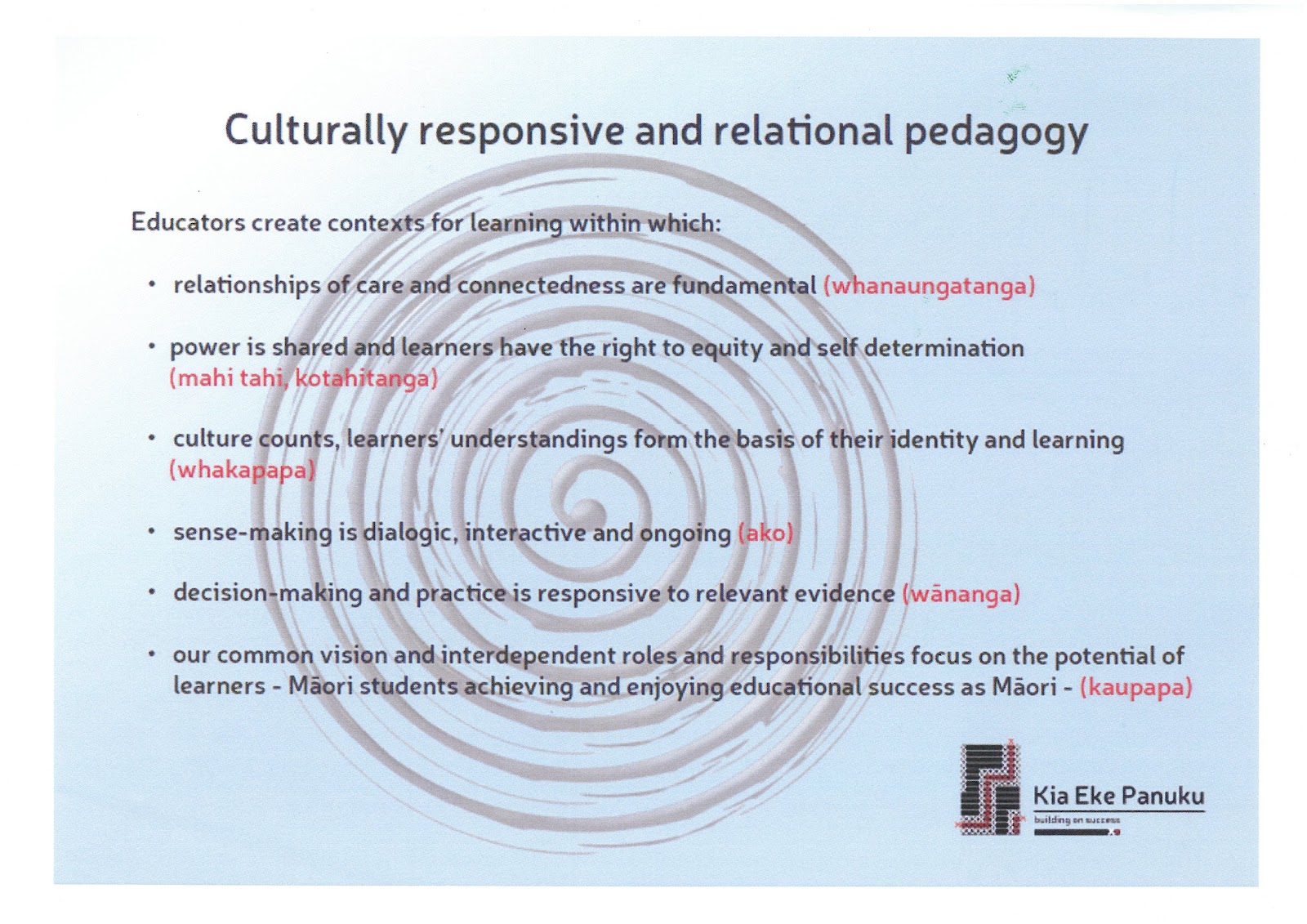
      The following are some examples of how various aspects of VTaL may be utilised and align with contexts of Culturally Responsive and Relational Pedagogy.  The examples below are embedded within the unit plan that I will be delivering during JumpStart this year, 11DGT Create a Web Page US18734.

      Whanaungatanga - Where relationships of care and connectedness are fundamental.
      Collaborative Learning Opportunities are provided for students:
      • Class discussions about context ideas
      • Sharing completed tasks in Google+ as a tool to guide the learning of others
      • +1 and Commenting on tasks shared in Google+
      • Peer feedback in Evaluations

      Mahi Tahi Kotahitanga - Where power is shared and learners have the right to self-determination.
      Empowerment for students:
      • Students can use Student Check Lists to track their own progress within this unit of work
      • Wananga between kaiako-tauira to select standards according to their interest in IT and DigiTech.  The standards available in DigiTech can be located within the DigiTech site under each NCEA Level (Assessment Information, and, Overview and Calendar)

      Ako - Where learning is interactive and spirals.
      Ako is interactive and spirals in terms of learning workflow, by applying the following in the learning process:
      • Year Level Calendar, Project Instructions, Learning Activities, and Student Progress (Class Task Lists and Student Checklists) are embedded in the Subject Google Site, and visible to learners
      • Year Level Calendar with Hyperlinked Learning Activities communicates the focus for the lesson each day and is a rewindable resource
      • Project Instructions communicates the big picture of the project to students
      • Learning Activities communicates the individual task requirements to students
      • Student Progress (Class Task Lists) communicates to students where students are tracking at with regards to task completion towards completing the overall standard
      • Communities provides examples of work to guide learning

      Wananga - Decision-making and practice in response to relevant evidence.
      Kaiako-Tauira Wananga are provided for students:
      • Use Class Task Lists and Student Check Lists to have discussions around progress and support for developing learning
      • Wananga between kaiako-tauira to select standards according to their interest in IT and DigiTech.  The standards available in DigiTech can be located within the DigiTech site under each NCEA Level (Assessment Information, and, Overview and Calendar)

      Share
      Tweet
      Pin
      Share
      No Comments


      Image result for unit plan


      The unit of work that I am delivering for the JumpStart program in Term 4 is 11DGT Create a Web Page US18734.  The unit plan itself shows the extent to which VTaL Visible Teaching and Learning can be integrated into all aspects of learning within the unit of work.  The unit plan template has been developed by Middle Leaders in consultation with the Senior Leadership Team, Curriculum Committee and Teaching Staff, to encapsulate aspects of the Curriculum.

      The following are sections of the unit plan that applies various components of VTaL Visible Teaching and Learning:
      • Teaching and Learning - Learning Activities, Resources
      • Assessment - Prior Assessment, Formative Assessment, Summative Assessment
      • RISE Values - Respect, Integrity, Success, Responsibility
      • NZC Key Competencies - Thinking, Relating to Others, Understanding Language, Symbols and Text, Managing Self, Participating and Contributing
      • SAMR - Redefinition
      • NZC Literacy and Numeracy - Literacy
      • SOLO Taxonomy - Unistructural (Identify), Multistructural (Describe), Relational (Apply), Extended Abstract (Evaluate)
      • Differentiation - Process, Learning Environment
      • Kia Eke Panuku - Whanaungatanga, Mahi Tahi Kotahitanga, Wananga
      • Career Management Competencies - Exploring Opportunities, Deciding and Acting

      Share
      Tweet
      Pin
      Share
      No Comments
      Older Posts

      About Me

      Kia ora! I am the Head of Technology at Tāmaki College and also teach Digital Technologies.


      My target group of learners for my Inquiry 2021 will be my Year 12 NCEA Level 2 class. This group of learners were my target group from my 2020 Inquiry. I would like to inquire into whether Academic Writing exemplars specific to Digital Technologies, in conjunction with the 'Explanation Writing' classroom display resources for Digital Technologies, based on SOLO taxonomy, could accelerate achievement in literacy in my subject.


      My target group of learners for my Inquiry 2020 were my Year 11 NCEA Level 1 class. I inquired into the process of using the LearnCoach online programs (content) and VTaL Visible Teaching and Learning (workflow) to accelerate student achievement for Tamaki College students undertaking courses in Digital Technologies NCEA Levels 1, 2 and 3.


      In 2019, my inquiry is to maximise pedagogical practices (relating to integrated education, and collaborative teaching and learning), to effectively shift student achievement, supported by digital platforms connected to visible teaching and learning.


      My Inquiry in 2018, was to develop a VTaL Purpose-Built Innovative Tool, to enable all elements of the VTaL Framework to be accessible to teachers, in order to accelerate student achievement.


      In 2017, my inquiry was based on raising student achievement and shifting teacher practice around effective pedagogical practices including Learn, Create and Share. This will be achieved through the development, implementation and monitoring of the Visible Teaching and Learning Framework.

      recent posts

      Blog Archive

      • ▼  2022 (8)
        • ▼  March (3)
          • Hybrid Teaching and Learning | The impact of Omicron
          • Manaiakalani Toolkit | Well-being - Supporting Our...
          • Technology - Manaiakalani Department Discussions M...
        • ►  February (5)
      • ►  2021 (16)
        • ►  November (1)
        • ►  September (2)
        • ►  August (1)
        • ►  July (2)
        • ►  June (4)
        • ►  May (3)
        • ►  March (2)
        • ►  February (1)
      • ►  2020 (42)
        • ►  November (2)
        • ►  September (2)
        • ►  August (7)
        • ►  July (5)
        • ►  June (4)
        • ►  May (7)
        • ►  April (7)
        • ►  March (3)
        • ►  February (4)
        • ►  January (1)
      • ►  2019 (30)
        • ►  September (2)
        • ►  August (3)
        • ►  July (1)
        • ►  June (2)
        • ►  April (1)
        • ►  March (12)
        • ►  February (9)
      • ►  2018 (41)
        • ►  November (7)
        • ►  October (2)
        • ►  September (1)
        • ►  August (4)
        • ►  July (4)
        • ►  May (7)
        • ►  April (4)
        • ►  March (5)
        • ►  February (7)
      • ►  2017 (65)
        • ►  December (2)
        • ►  November (22)
        • ►  October (6)
        • ►  September (6)
        • ►  August (10)
        • ►  June (4)
        • ►  May (3)
        • ►  April (1)
        • ►  March (4)
        • ►  February (6)
        • ►  January (1)
      • ►  2016 (26)
        • ►  December (1)
        • ►  November (18)
        • ►  September (6)
        • ►  August (1)

      VTaL

      • VTaL (104)
      • VTaL 01 Subject Sites (33)
      • VTaL 02 Learning Activities (7)
      • VTaL 03 Tracking Sheets (28)
      • VTaL 04 Student Checklists (12)
      • VTaL 05 Calendars with Links (24)
      • VTaL 06 Workspaces (32)
      • VTaL 07 Student Sites (4)
      • VTaL 08 Year Level Sites (3)
      • VTaL 09 Subject Communities (26)
      • VTaL 10 Student Blogs (11)
      • VTaL and Google Hangouts (15)
      • VTaL and Student Achievement (45)
      • VTaL for Parents (13)
      • VTaL for Students (82)
      • VTaL for Teachers (32)

      Presentations

      • GAFE (19)
      • My YouTube Videos (8)
      • Presentations (21)

      Inquiry

      • Inquiry (134)
      • Inquiry 2019 (27)
      • Inquiry 2020 (34)
      • Inquiry 2021 (15)

      Manaiakalani

      • CoL (167)
      • Inquiry (134)
      • Inquiry 2020 (34)
      • Learn Create Share (11)
      • MIT 2018 (16)
      • Manaiakalani (18)
      • Presentations (21)
      • SPARK MIT (59)

      Tamaki College

      • 2018 Department Goals (2)
      • 2018 School Goals (3)
      • 2019 Department Goals (2)
      • CoL (167)
      • Collaborative Learning Environments (32)
      • Covid19 (29)
      • Cultural Responsiveness (10)
      • Differentiation (12)
      • EMR Collaborative Project (21)
      • Goals (2)
      • Human Rights Collaborative Project (5)
      • Integrated Education (24)
      • Kia Eke Panuku (8)
      • LearnCoach (2)
      • Literacy (21)
      • PLD (18)
      • Techies (12)
      • Technological Modelling (4)

      Practicing Teacher Criteria

      • PTC01 (31)
      • PTC02 (9)
      • PTC03 (6)
      • PTC04 (61)
      • PTC05 (17)
      • PTC06 (42)
      • PTC07 (32)
      • PTC08 (34)
      • PTC09 (8)
      • PTC10 (7)
      • PTC11 (16)
      • PTC12 (54)

      General

      • CoL (167)
      • Collaborative Learning Environments (32)
      • Cultural Responsiveness (10)
      • Differentiation (12)
      • Feedback - Parent Voice (2)
      • Feedback - Staff Voice (6)
      • Feedback - Student Voice (23)
      • GAFE (19)
      • Goals (2)
      • Integrated Education (24)
      • Kia Eke Panuku (8)
      • LearnCoach (2)
      • Literacy (21)
      • My YouTube Videos (8)
      • Review (14)
      • Student Agency (15)

      Contact Form

      Name

      Email *

      Message *

      Total Pageviews

      Created with by BeautyTemplates| Distributed By Gooyaabi Templates