My Space and My Place

    • Home
    • Inquiry 2021
    • Digital Technologies Site
    • VTaL Site
    • VTaL G+


Technology Literacy Resources

The following is School Goal 2 focussing on Literacy and Numeracy

School Goal 2 Literacy and Numeracy
That 80% of Year 9 & 10 students are reading at or above the expected Curriculum Level.
That 70% of Year 9 & 10 students are writing at or above the expected Curriculum Level.
That 70% of Year 9 & 10 students are achieving in Mathematics at or above the expected Curriculum Level.

That 90% of Year 11 students will achieve NCEA Literacy.

That 80% of Year 11 students will achieve NCEA Numeracy.

Technology Literacy Resources

The following are literacy resources that were used in a session with Marc Milford to implement literacy strategies in Technology around 'Language Writing Skills' and 'Language Features'.

The PD Tech resource that Marc focussed on for the Technology Department was 91044 Brief Development.  The reason I asked Marc to focus on Brief Development at NCEA Level 1, is because all Technology teachers from Year 7 through to Year 13 teach the Brief Development achievement objective, and three staff deliver the Brief Development NCEA standard to Level 1, Level 2 or Level 3.

PD Tech

Readings

AS91044 Exemplar - Low Excellence

91044-EXP-student1-001
91044-EXP-student1-002


Take Outs from our PD Session with Marc

The following are some take outs that I have from the PD Session with Marc:

  1. I need time to process the strategies that Marc has supplied us with in the Writing plan 2018 for Techies
  2. I would benefit from one on one time to identify specific literacy strategies to help with both my senior students as well as my junior students
  3. I'd like some more department time for us to collaborate on, and gain a shared understanding on some useful strategies for literacy issues within Technology
Share
Tweet
Pin
Share
3 Comments

The following post is a reflection on Department Goal 2.

Department Goal Idea 2

Reflections - 15mins Blogging in Dept Meetings


The way in which the goal has been executed within department meeting time is as follows:

  1. Blog Post Reflections - Staff blog their reflections on either a particular School Goal or Department Goal.  The focus is determined prior to blogging.  Staff publish their blog posts, and then share their post within the TC Techies Google+ Community under the category of School Goals or Technology Department Goals.  The sharing within the TC Techies G+ Community, is so that posts can be easily located by other members of the department on a common topic shared under a specific category label.
  2. Blog Comments - Staff locate each other's blog posts, read through, and then comment on the posts.
  3. Discussions - We then discuss what we've learnt from either our reflection and the comments on our reflections, or, what we've learnt from other people's reflections.

The process has enabled a level of connectedness whereby staff have a digital and rewindable portal of their reflections and comments, a sense of shared purpose through blogging on the same area of focus, and then another level of connectedness through the discussions.  This includes ideas around teaching and learning approaches or experiences that are the same as each other, as well as different as each other.  In addition, the digital feedback and discussion feedback often leads to ideas or takeouts, for issues that we may be experiencing in our own work area.

Initially, the department goal idea was to spend 15 minutes blogging.  However, when we undertook the blogging process within the department meeting for the first time, it became clear that 15 minutes probably wasn't going to cut it!  The blogging timeline probably takes us approximately 20-30 minutes, from the start of the blog post, publishing the blog post, and then sharing the post into the TC Techies Google+ Community.  Then we spend approximately 10-15 minutes commenting on each others posts, and another 10-15 minutes discussing what we'd learnt.

Although the time allocation is way beyond our initial expectation, the benefits of investing the time into this process far outweighs the extra time expended.  The 'Blog-Comment-Discuss' process provides a real sense of collegiality, whereby staff can feed into discussions (both digitally and face-to-face), as well as gain take-outs from the discussions.

The Blog-Comment-Discuss sessions have so far included:

School Goal 1 Maori Achievement
  • Goal 1 : Maori Achievement
  • Reflection on School Goal 1
  • Reflecting on School Goal 1
  • To Raise Maori Achievement and Cultural Visibility
  • VTaL : Mahi Tahi and Manaakitanga - Tuakana-Teina

School Goal 4 Attendance
  • School Goal 4 Attendance - That 60% of Students will have 90% Attendance

Technology Department Goal 1
  • Reflection of Term 1 Sharing Goal
  • VTaL : Reflection on Department Goal 1
  • Reflecting on Department Goal 1 Share
  • Department Goal 1 - Reflection on Share
  • Reflecting on Department Goal 1 - Share

School Goal 3 Transition

  • Reflecting on School Goal 3 in Term 1


Share
Tweet
Pin
Share
No Comments

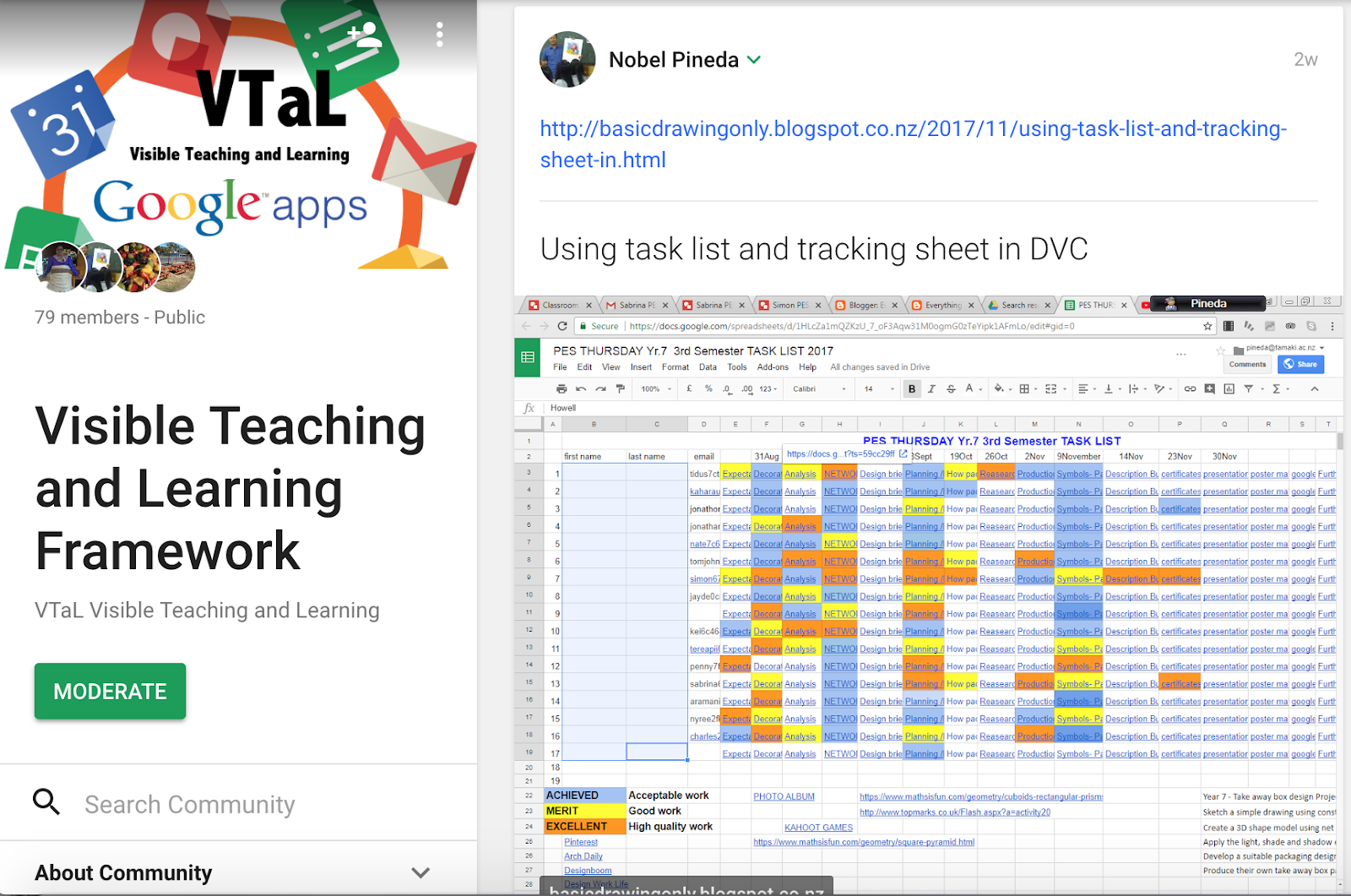
I had the privilege of presenting at the EdTech Team Auckland GAFE Summit held at Aorere College.  The focus of my session was VTaL - Tracking Student Progress.    In 2017, I delivered a session entitled VTaL Visible Teaching and Learning in a Secondary School Context.  This year's session was an opportunity to focus in on one of the VTaL tools, Tool 03 : Class Project Task Lists, and provide examples of how I have used the tracking sheets to inform my practice, and accelerate student achievement.

I always find it greatly satisfying having the opportunity to share my experiences, the trials, tribulations and everything in between, with fellow teaching practitioners, if it is going to enable them to learn from both my success moments as well as my mistakes.


Tracking sheets and monitoring systems are certainly not a new concept.  They've been around as far back as assessment has ever existed.  However, tracking sheets, marking sheets, checklists etc are completely pointless if they are not going to be used to Inform Teacher Practice, and, Accelerate Student Achievement.  It doesn't matter how many bells, whistles, colours, links, gifs or emojis can be dropped into tracking sheets.  If the tracking sheet isn't used to Inform Teacher Practice, and Accelerate Student Achievement, then as a tool, the tracking sheet is pointless.

EdTech Akld 2018 : VTaL - Tracking Student Progress


Was the presentation useful?

Of the many people who attended the presentation, the following is a snapshot of feedback from some of the attendees:

Share
Tweet
Pin
Share
2 Comments

Department Goal 1 for 2018 is that 'Share' to be undertaken using the following:

  • Year 7-9 Blogs
  • Year 10 Google+
  • Seniors


‘Share’ Opportunities in DigiTech

The following are examples of various ‘Share’ Opportunities in Term 1 for students taking DigiTech:

Year 7-9

Year 7 students have been blogging about Technology when they come on Fridays.  I have not successfully and consistently prompted the Year 9 class to blog this term.

Year 10

Year 10 students have blogged about different DigiTech experiences in Term 1.  In addition to this, Year 10 students have been sharing and contributing into the Year 10 DigiTech Google+ Community for Brief Development.

Year 11 NCEA Level 1

Year 11 students have been sharing and contributing into the Level 1 DigiTech at Tamaki College Google+ Community for their first project this year, Create a Game.

Year 12 NCEA Level 2

Year 12 students have been sharing and contributing into the Level 2 DigiTech at Tamaki College Google+ Community for their first project this year, Create a Website.

Year 13 NCEA Level 3

Year 13 students have been sharing and contributing into the Level 3 DigiTech at Tamaki College Google+ Community for their first and second projects this year, Project Management, and Conceptual Design.

Impact of ‘Share’ Opportunities in DigiTech for Students


I have not effectively enabled 'share' to occur in a constructive and consistent manner with my early junior classes.  I have to reflect on lesson structure and integrating time to blog within the teaching and learning time within the week.

Year 10 blogging and sharing into the Google+ community has also been sporadic and inconsistent.  However, when blogging and sharing into G+ has occurred, the sharing component has been extensive in terms of the stakeholders (Accenture Staff) who have interacted with the students.

The Level 1, Level 2 and Level 3 sharing into Google+ communities has been far more consistent, and constructive for student learning so far in Term 1.  Students understand the value of sharing their work into the community, as they can see how they themselves, as well as their peers, learn from the work that is shared.  Students only share work that has been assessed and returned to them.  Students also don't require prompting to upload work into the communities, as they tend to do this on most occasions themselves.


Share
Tweet
Pin
Share
3 Comments
On the weekend, myself and my MIT 2018 colleagues participated in our first professional development session for this year.  The weekend was broken up into different workshops, investigating the 'Why', 'Who', 'Design Thinking' and 'Crazy 8s' associated with our inquiries.


Why?

  • Escalator Challenge
  • Role Play: King of the Mountain

In order to delve deeper into the 'Why?' for each of our inquiries, we participated in a couple of different role play scenarios.  One was the 'King of the Mountain', whereby we had different roles to enable people to reach the top of the mountain.

The other was a 'Parents Evening with the Head of the School'.  Some found it easier to question others while role playing, some were indifferent.

My initial hold up for not inquiring more into the 'why' for my peers in the month prior to this weekend, was the need to know more about the big picture of the puzzle, as well as the individual puzzle pieces that combine to make the puzzle.  So, more of the what before the why.  During the role play, as many why questions were firing in from within our group, some of the whats that were initially gaps for me were filled in, which gave me enough background to ask (what I believed to be) useful why questions.  I was indifferent about having a role (neither positively or negatively), as I would likely have answered the questions inadvertently as myself anyway.

In terms of the why questions that culminated out of the why role play relating to my inquiry, I appreciated that the questions were forthcoming.  When I'm being asked questions, either what, why or anything else, it gives me the opportunity to reflect and clarify what I'm trying to articulate and communicate.  Being questioned also reduces or minimizes assumptions of what others may perceive to be my thinking, as opposed to what my thinking actually is.  This is significant and a huge help.


Who?

  • Who does this Moonshot project involve?
  • Who am I collaborating with on this project?
  • Who are my team?
  • Who has a voice in this project?
  • Learners - exactly who
  • Colleagues: co-designers, collaborators, sounding boards etc
  • Experts: who is being invited to add expert opinion

Identified Stakeholders
When I first approached this activity, I went through it as I usually would, and if I didn't know the answer to something, I'd answer as best I could (or thought that I could).  Dorothy challenged me on this, as there were blanks in my first draft.

I was convinced that what I had was what I knew, until I could go off and investigate.  Apparently this was not the case.  Throughout this session, I spent long periods of time with very little information flowing; often 10-15mins at a time of nothing, almost like 'writers block'.  And then Boom! download download download, the info came flooding out and straight onto the page.

In a busy normal 'day in the life of', I wouldn't usually wait long enough to download in depth.  On reflection, this made me think about my approach to really delving deep into an area that I am truly  passionate about, and that is, "removing barriers to learning in order to maximize learning opportunities for our students".  How much am I skim thinking due to not downloading in depth?  What am I missing out on?  Do I have to go away on a retreat in order to download properly ... no seriously, if this is what is going to make me more effective as a practitioner, than maybe this is what needs to happen!

Anyway, I came away with a range of stakeholders; those who could be my 'Squad', my people, my next points of reference to point me in the right or next direction.


Design Thinking - Discovery and Interpretation

The first step in the design process involves learning as much as possible about the problem by understanding both the context of the situation and understanding the problem at hand from the perspective of the "user".

This was a great activity to reflect on, refine or in some cases, redefine, the problem associated with our inquiries.  My inquiry has culminated out of years of learning and development of the technical skills, pedagogical understandings and implementation of Learn, Create, Share and Visible Teaching and Learning in my teaching and learning setting, and how that might relate to others.

Adapting the Focus
The original problem that I'd identified had evolved over time.  And so, the first statement relates to the original problem, whilst the second statement relates to the new problem (as it has evolved):
  1. Reduce the disparity of the inconsistencies through the development of the VTaL framework
  2. Expand the opportunities of access to VTaL on a global level through the development of a VTaL Mobile App
 

The Crazy 8's

The Crazy 8's was an activity that enabled us to come up with eight potentially crazy ideas around either processes or outcomes that addresses our identified problem.  Due to the fact that the problem that I would like to address is directly related to learner outcomes, I developed Crazy 8's on learner outcomes.  In hindsight, and to connect more coherently and closely to the problem that I have identified, I should look at Crazy 8's that could potentially assist teachers and teaching practitioners.


Reflection Time

It was great coming away from the weekend and being able to reflect on everything that I had learnt and gained along the way.  It's amazing what comes to mind when you're connecting with your thoughts in the great outdoors.  I look to refining my inquiry in the coming weeks, in the lead up to our next gathering at KPMG.

I'd like to take the opportunity to thank Dorothy for organising the weekend for us, and for the fantastic location.  Huge thanks to Jenny and Anne for looking after us while we were away.  Heaps of aroha out to my amazing MIT colleagues (Jackie, Clarelle, Rebecca, Kariene, Heather, Zac, Danni and Jacob), whose vision, feedback, and thought provoking ideas both challenged and inspired my own thinking over these past few days.  Nga mihi nui ki a koutou!


Share
Tweet
Pin
Share
No Comments

Focus Class for the Goal

Technology Students

Goals and Actions - Student learning and achievement

To improve outcomes for students in my department by modelling effective teacher practice to Technology staff and assisting staff to apply various VTaL components of Learn Create and Share for learners.

Goals and Actions - Teacher learning and achievement

To discuss with Technology  staff which standard (or project) will be the focus for applying VTaL to, and assist staff to set this process up.

Goals and Actions - Reflections

Staff trialled VTaL with a particular class.  In my Impact Burst 2017! post, I briefly outline some of the outcomes from this goal in the section entitled ‘Taking the Journey with Technology Staff’.  This included breaking down some of the VTaL tools that staff could focus on integrating into their subject sites for 2018.

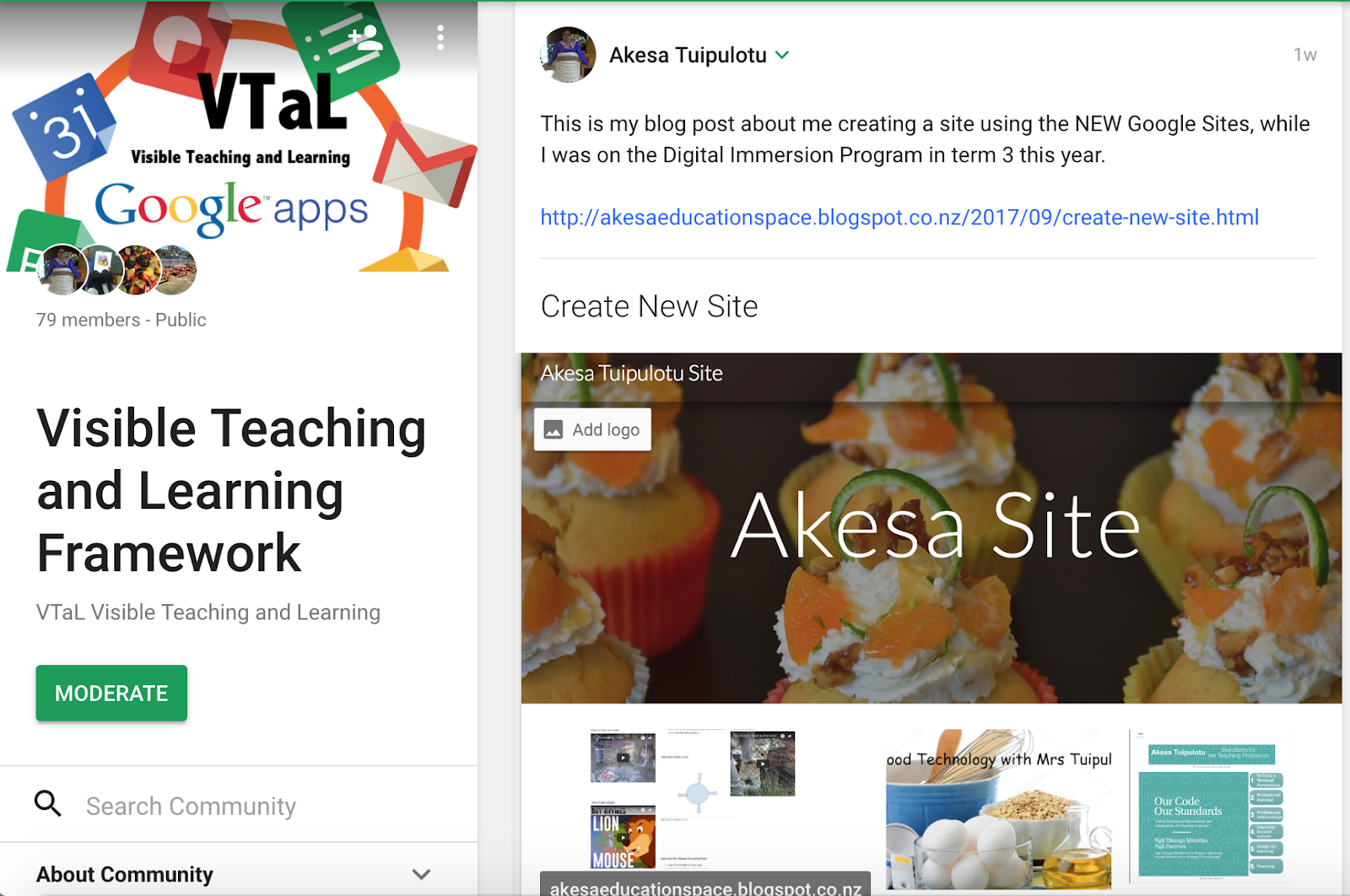
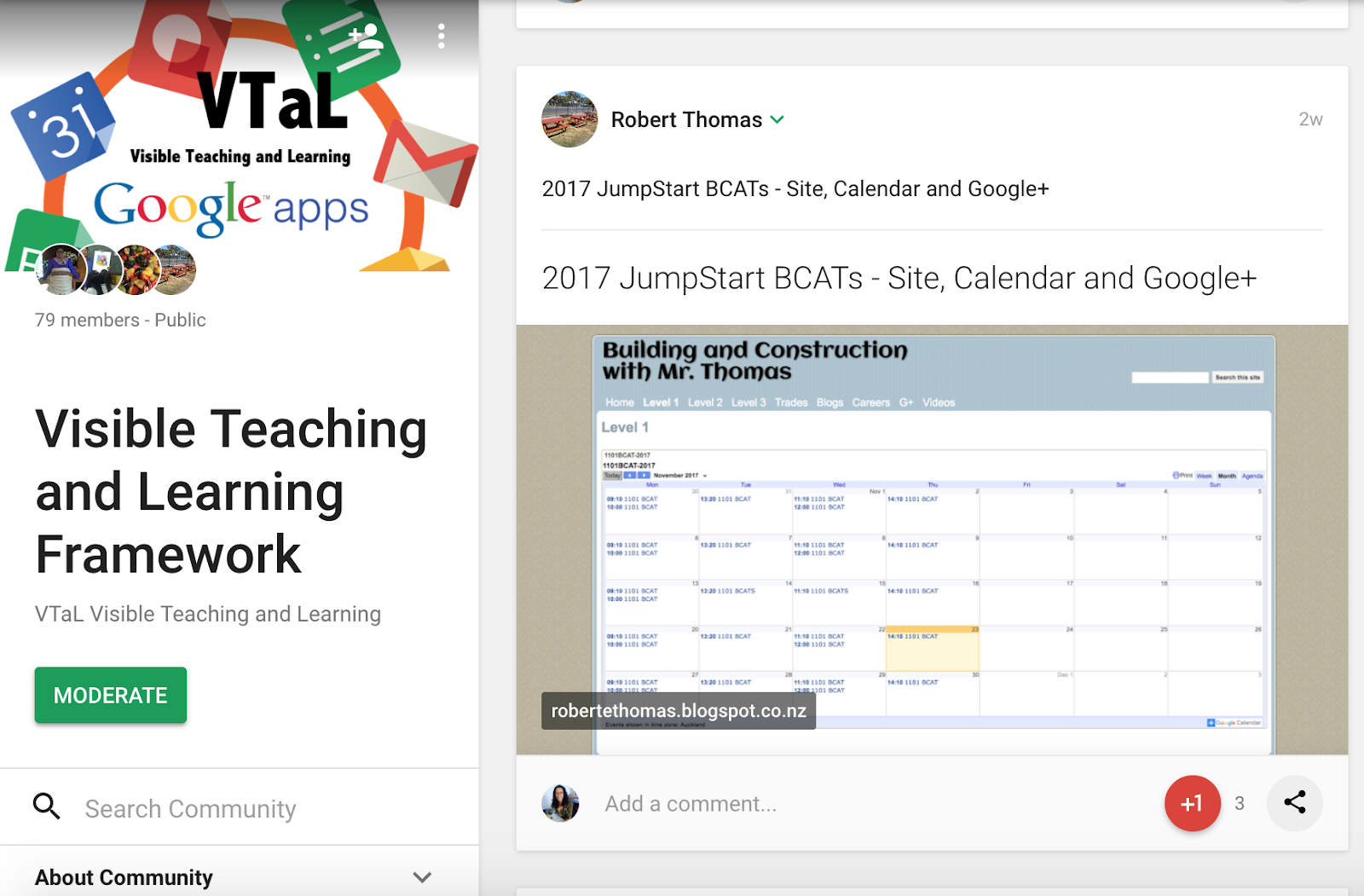
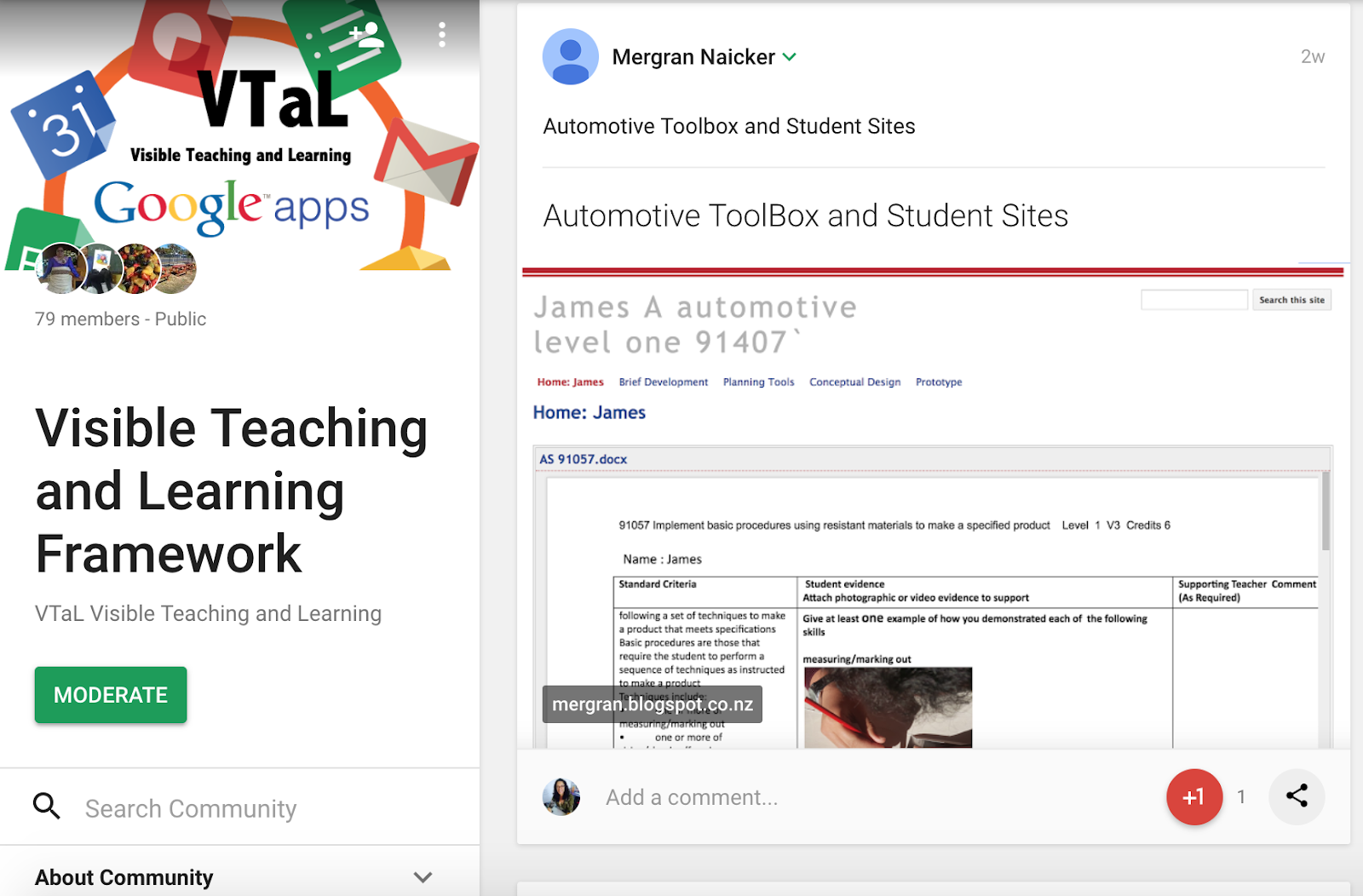
Some of the Technology Staff also blogged about their experience with the use of the some or a particular VTaL tool, which they were then able to share into the VTaL Google+ Community.  These are particularly insightful in terms of:
  • Promoting student engagement and motivation
  • Setting up classroom routines
  • Integrating theory and practical lessons together
  • Developing rewindable resources

I am extremely proud of the work that the Technology staff have put into the use of various VTaL tools so far this year.  They’ve all done well within their own journeys of integrating VTaL into their classrooms, and I look forward to ongoing developments in 2018.

The following images link to the various blog posts shared into the VTaL Google+ Community.


Share
Tweet
Pin
Share
2 Comments

Focus Class for the Goal

Māori students in NCEA Level 1, NCEA Level 2 and NCEA Level 3

Goals and Actions - Student learning and achievement

To improve outcomes for students in my classes by making changes or adjustments to my teacher practice by  tracking the attendance and achievement of Māori students in my NCEA Level 1, Level 2 and Level 3 multi-level class, and communicating this information to students on a regular basis.

Goals and Actions - Teacher learning and achievement

  • To develop a digital process and system to collect regular data on achievement and attendance.
  • To digitally share the data on achievement and attendance with the students.
  • To have one to one meetings with students whose attendance or incomplete work leaves the student at risk of not achieving.
  • To contact home for students whose attendance or incomplete work leaves the student at risk of not achieving.
  • To enter updates into Kamar for issues relating to achievement and attendance.

Goals and Actions - Reflections

The initial template turned out to not be a sustainable resource.  I then developed a different process that integrates achievement data with student attendance.

This aligns with the data summary sheets in Kamar that is used to discuss student achievement with SLT.  The Student Standard Data Update - Templates enable an overview of the formative feedback relating to students with regards standards the students have achieved, standards the students are working on, credits offered to each student, attendance, teaching strategies and interventions, student actions, and any other notes that are not picked up through summative feedback in Kamar.

The sheets also included meeting updates between myself and individual students, which I then shared with the students, so that they had a copy of the feedback to action in terms of the project they were currently working on.  This also enabled me to track the conversations that I'd had with students, as well as the actions that the students either had, or had not, followed up on.

Goals and Actions - Future Focus 2018

I have shared the process with staff in the Technology Department and have developed a template for Technology Staff to use in 2018.  Student Standard Data Update - Template.

This will enable each staff member, as well as myself, to know and understand where each Senior Student who takes a Technology subject, is tracking throughout each term, and from one term to the next.

Share
Tweet
Pin
Share
No Comments

Practising Teacher Criteria

Introduction
Overarching statements
Criteria and key indicators
Professional relationships and professional values
Professional knowledge in practice

Introduction

The Practising Teacher Criteria describe the criteria for quality teaching that are to be met by all fully certificated teachers in Aotearoa New Zealand.
The Practising Teacher Criteria recognise that teaching is a highly complex activity, drawing on repertoires of knowledge, practices, professional attributes and values to facilitate academic, social and cultural learning for diverse education settings. The criteria and indicators should be viewed as interdependent and overlapping.

Overarching statements

  1. Teachers play a critical role in enabling the educational achievement of all ākonga/ learners 1.
  2. The Treaty of Waitangi extends equal status and rights to Māori and Pākehā. This places a particular responsibility on all teachers in Aotearoa New Zealand to promote equitable learning outcomes.
  3. In an increasingly multi-cultural Aotearoa New Zealand, teachers need to be aware of and respect the languages, heritages and cultures of all ākonga.
  4. In Aotearoa New Zealand, the Code of Ethics / Ngā Tikanga Matatika commits certificated teachers to the highest standards of professional service in promoting the learning of those they teach.

Criteria and key indicators

PROFESSIONAL RELATIONSHIPS AND PROFESSIONAL VALUES

Fully certificated teachers engage in appropriate professional relationships and demonstrate commitment to professional values.
Fully certificated teachers:
CriteriaKey Indicators
1. establish and maintain effective professional relationships focused on the learning and well-being of ākonga
i. engage in ethical, respectful, positive and collaborative professional relationships with:
  • ākonga
  • teaching colleagues, support staff and other professionals
  • whānau and other carers of ākonga
  • agencies, groups and individuals in the community
2. demonstrate commitment to promoting the well-being of all ākonga
i. take all reasonable steps to provide and maintain a teaching and learning environment that is physically, socially, culturally and emotionally safe
ii. acknowledge and respect the languages, heritages and cultures of all ākonga
iii. comply with relevant regulatory and statutory requirements
3. demonstrate commitment to bicultural partnership in Aotearoa New Zealand 
i. demonstrate respect for the heritages, languages and cultures of both partners to the Treaty of Waitangi
4. demonstrate commitment to ongoing professional learning and development of personal professional practice
i. identify professional learning goals in consultation with colleagues
ii. participate responsively in professional learning opportunities within the learning community
iii. initiate learning opportunities to advance personal professional knowledge and skills
5. show leadership that contributes to effective teaching and learning
i. actively contribute to the professional learning community
ii. undertake areas of responsibility effectively


PROFESSIONAL KNOWLEDGE IN PRACTICE

Fully certificated teachers make use of their professional knowledge and understanding to build a stimulating, challenging and supportive learning environment that promotes learning and success for all ākonga.
Fully certificated teachers:
CriteriaKey Indicators
6. conceptualise, plan and implement an appropriate learning programme
i. articulate clearly the aims of their teaching, give sound professional reasons for adopting these aims, and implement them in their practice
ii. through their planning and teaching, demonstrate their knowledge and understanding of relevant content, disciplines and curriculum documents
7. promote a collaborative, inclusive and supportive learning environment
i. demonstrate effective management of the learning setting which incorporates successful strategies to engage and motivate ākonga
ii. foster trust, respect and cooperation with and among ākonga
8. demonstrate in practice their knowledge and understanding of how ākonga learn
i. enable ākonga to make connections between their prior experiences and learning and their current learning activities
ii. provide opportunities and support for ākonga to engage with, practise and apply new learning to different contexts
iii. encourage ākonga to take responsibility for their own learning and behaviour
iv. assist ākonga to think critically about information and ideas and to reflect on their learning
9. respond effectively to the diverse language and cultural experiences, and the varied strengths, interests and needs of individuals and groups of ākonga
i. demonstrate knowledge and understanding of social and cultural influences on learning, by working effectively in the bicultural and multicultural contexts of learning in Aotearoa New Zealand
ii. select teaching approaches, resources, technologies and learning and assessment activities that are inclusive and effective for diverse ākonga
iii. modify teaching approaches to address the needs of individuals and groups of
ākonga
10. work effectively within the bicultural context of Aotearoa New Zealand
i. practise and develop the relevant use of te reo Māori me ngā tikanga-a-iwi in context
ii. specifically and effectively address the educational aspirations of ākonga Māori, displaying high expectations for their learning
11. analyse and appropriately use assessment information, which has been gathered formally and informally
i. analyse assessment information to identify progress and ongoing learning needs of ākonga
ii. use assessment information to give regular and ongoing feedback to guide and support further learning
iii. analyse assessment information to reflect on and evaluate the effectiveness of the teaching
iv. communicate assessment and achievement information to relevant members of the learning community
v. foster involvement of whānau in the collection and use of information about the learning of ākonga
12. use critical inquiry and problem-solving effectively in their professional practice
i. systematically and critically engage with evidence and professional literature to reflect on and refine practice
ii. respond professionally to feedback from members of their learning community

iii. critically examine their own beliefs, including cultural beliefs, and how they impact on their professional practice and the achievement of ākonga
In this document, the term akonga has been chosen to be inclusive of all learners in the full range of settings, from early childhood to secondary and beyond, where the Practising Teacher Criteria apply.
Share
Tweet
Pin
Share
No Comments

Achievement Challenge

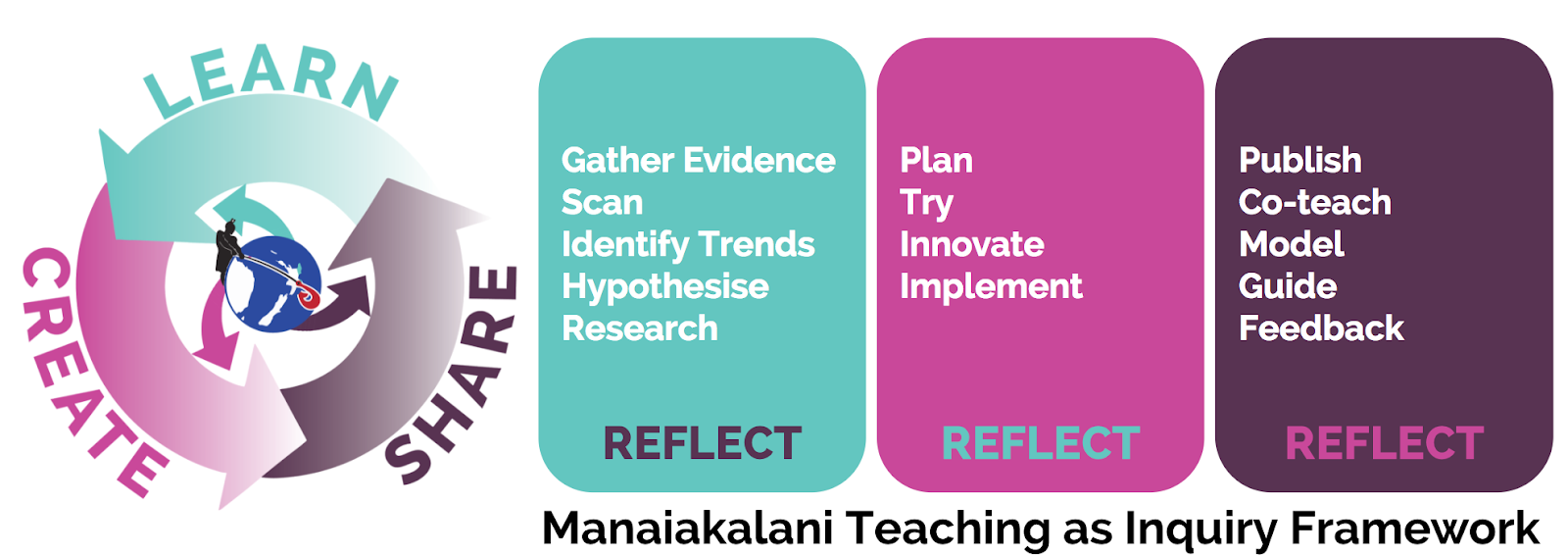
My Inquiry for 2018 will extend from my 2017 Inquiry, and relates to the Manaiakalani  CoL Achievement Challenge 1.

Achievement Challenge 1 : To raise Māori student achievement through the development of cultural visibility and responsive practices across the pathway as measured against National Standards and agreed targets for reading Years 1-10 and NCEA years 11-13.

Inquiry 2018

In 2018, my inquiry will be based on raising student achievement and shifting teacher practice around effective pedagogical practices including Learn, Create and Share. This will be achieved through the development, implementation and monitoring of the Visible Teaching and Learning Framework. This will involve further development and refinement of digital tools within the framework, to enable sustainable and effective pedagogical practices to occur, that positively impacts on student achievement.


Thanks to Karen Ferguson for the graphic design.


Manaiakalani CoL : Teaching Inquiry Framework

Manaiakalani CoL : Teaching Inquiry Framework Template


Share
Tweet
Pin
Share
No Comments
Older Posts

About Me

Kia ora! I am the Head of Technology at Tāmaki College and also teach Digital Technologies.


My target group of learners for my Inquiry 2021 will be my Year 12 NCEA Level 2 class. This group of learners were my target group from my 2020 Inquiry. I would like to inquire into whether Academic Writing exemplars specific to Digital Technologies, in conjunction with the 'Explanation Writing' classroom display resources for Digital Technologies, based on SOLO taxonomy, could accelerate achievement in literacy in my subject.


My target group of learners for my Inquiry 2020 were my Year 11 NCEA Level 1 class. I inquired into the process of using the LearnCoach online programs (content) and VTaL Visible Teaching and Learning (workflow) to accelerate student achievement for Tamaki College students undertaking courses in Digital Technologies NCEA Levels 1, 2 and 3.


In 2019, my inquiry is to maximise pedagogical practices (relating to integrated education, and collaborative teaching and learning), to effectively shift student achievement, supported by digital platforms connected to visible teaching and learning.


My Inquiry in 2018, was to develop a VTaL Purpose-Built Innovative Tool, to enable all elements of the VTaL Framework to be accessible to teachers, in order to accelerate student achievement.


In 2017, my inquiry was based on raising student achievement and shifting teacher practice around effective pedagogical practices including Learn, Create and Share. This will be achieved through the development, implementation and monitoring of the Visible Teaching and Learning Framework.

recent posts

Blog Archive

  • ▼  2022 (8)
    • ▼  March (3)
      • Hybrid Teaching and Learning | The impact of Omicron
      • Manaiakalani Toolkit | Well-being - Supporting Our...
      • Technology - Manaiakalani Department Discussions M...
    • ►  February (5)
  • ►  2021 (16)
    • ►  November (1)
    • ►  September (2)
    • ►  August (1)
    • ►  July (2)
    • ►  June (4)
    • ►  May (3)
    • ►  March (2)
    • ►  February (1)
  • ►  2020 (42)
    • ►  November (2)
    • ►  September (2)
    • ►  August (7)
    • ►  July (5)
    • ►  June (4)
    • ►  May (7)
    • ►  April (7)
    • ►  March (3)
    • ►  February (4)
    • ►  January (1)
  • ►  2019 (30)
    • ►  September (2)
    • ►  August (3)
    • ►  July (1)
    • ►  June (2)
    • ►  April (1)
    • ►  March (12)
    • ►  February (9)
  • ►  2018 (41)
    • ►  November (7)
    • ►  October (2)
    • ►  September (1)
    • ►  August (4)
    • ►  July (4)
    • ►  May (7)
    • ►  April (4)
    • ►  March (5)
    • ►  February (7)
  • ►  2017 (65)
    • ►  December (2)
    • ►  November (22)
    • ►  October (6)
    • ►  September (6)
    • ►  August (10)
    • ►  June (4)
    • ►  May (3)
    • ►  April (1)
    • ►  March (4)
    • ►  February (6)
    • ►  January (1)
  • ►  2016 (26)
    • ►  December (1)
    • ►  November (18)
    • ►  September (6)
    • ►  August (1)

VTaL

  • VTaL (104)
  • VTaL 01 Subject Sites (33)
  • VTaL 02 Learning Activities (7)
  • VTaL 03 Tracking Sheets (28)
  • VTaL 04 Student Checklists (12)
  • VTaL 05 Calendars with Links (24)
  • VTaL 06 Workspaces (32)
  • VTaL 07 Student Sites (4)
  • VTaL 08 Year Level Sites (3)
  • VTaL 09 Subject Communities (26)
  • VTaL 10 Student Blogs (11)
  • VTaL and Google Hangouts (15)
  • VTaL and Student Achievement (45)
  • VTaL for Parents (13)
  • VTaL for Students (82)
  • VTaL for Teachers (32)

Presentations

  • GAFE (19)
  • My YouTube Videos (8)
  • Presentations (21)

Inquiry

  • Inquiry (134)
  • Inquiry 2019 (27)
  • Inquiry 2020 (34)
  • Inquiry 2021 (15)

Manaiakalani

  • CoL (167)
  • Inquiry (134)
  • Inquiry 2020 (34)
  • Learn Create Share (11)
  • MIT 2018 (16)
  • Manaiakalani (18)
  • Presentations (21)
  • SPARK MIT (59)

Tamaki College

  • 2018 Department Goals (2)
  • 2018 School Goals (3)
  • 2019 Department Goals (2)
  • CoL (167)
  • Collaborative Learning Environments (32)
  • Covid19 (29)
  • Cultural Responsiveness (10)
  • Differentiation (12)
  • EMR Collaborative Project (21)
  • Goals (2)
  • Human Rights Collaborative Project (5)
  • Integrated Education (24)
  • Kia Eke Panuku (8)
  • LearnCoach (2)
  • Literacy (21)
  • PLD (18)
  • Techies (12)
  • Technological Modelling (4)

Practicing Teacher Criteria

  • PTC01 (31)
  • PTC02 (9)
  • PTC03 (6)
  • PTC04 (61)
  • PTC05 (17)
  • PTC06 (42)
  • PTC07 (32)
  • PTC08 (34)
  • PTC09 (8)
  • PTC10 (7)
  • PTC11 (16)
  • PTC12 (54)

General

  • CoL (167)
  • Collaborative Learning Environments (32)
  • Cultural Responsiveness (10)
  • Differentiation (12)
  • Feedback - Parent Voice (2)
  • Feedback - Staff Voice (6)
  • Feedback - Student Voice (23)
  • GAFE (19)
  • Goals (2)
  • Integrated Education (24)
  • Kia Eke Panuku (8)
  • LearnCoach (2)
  • Literacy (21)
  • My YouTube Videos (8)
  • Review (14)
  • Student Agency (15)

Contact Form

Name

Email *

Message *

Total Pageviews

Created with by BeautyTemplates| Distributed By Gooyaabi Templates