My Space and My Place

    • Home
    • Inquiry 2021
    • Digital Technologies Site
    • VTaL Site
    • VTaL G+

As outlined in today's NZ Herald article, Covid19 Omicron outbreak: 15,540 new community cases, 952 in hospital, 2 deaths, Auckland covid cases are said to be "on a downward trend".  However, also stated in the article, "schools across the country are feeling the impact of the Omicron outbreak".  

What does this look like for "our" students?


Since the beginning of the 2022 school year, I have inquired into various aspects of Hybrid Teaching and Learning, and how this learning approach may be used to enable our learners to achieve.  As outlined from the list below, this has included inquiring into initial takes on Hybrid Teaching and Learning, Student Voice of Hybrid Teaching and Learning, what we've (Techies) learnt from Lockdowns, Understanding the variables to make it work, and the Hybrid Timetable.

  • Hybrid Teaching and Learning | Take 01
  • Hybrid Teaching and Learning | Take 01 - Student Voice from Learners In-Class Onsite
  • Hybrid Learning 2022 | Techies Learning from Lockdowns
  • Hybrid Teaching and Learning | Understanding the variables to make it work
  • Hybrid Teaching and Learning in our Hybrid Timetable

At this stage of the pandemic, with Omicron as the main Covid19 variant, and also at this stage of the year, it is too soon to come to any conclusions about the long term impacts or benefits of Hybrid Teaching and Learning for learners, but also the long term impacts or benefits to educators; particularly educators who are in the classroom.

What is clear is that teaching and learning has evolved, and continues to evolve at a frenetic pace, in response to the Covid19 pandemic.  It will be interesting to see what student achievement looks like as assessment data becomes available.


Share
Tweet
Pin
Share
No Comments


Last night I had the pleasure of presenting and sharing in the Manaiakalani Toolkit Session about Well-being - Supporting Our Educators through the Covid19 Pandemic.


Following our icebreaker activity, I proceeded to share a snapshot of the journey that I have taken the Technology Department through, to address our well-being throughout the Covid19 pandemic.

Knowing Your Team

Knowing Your Team - Connecting on the morning that our first lockdown was announced


Reflective Questions for Myself at this stage of the pandemic

  1. How do my staff feel about what’s happening around us (at the time), and how are we engaging with each other about ourselves and our households?
  2. How are we sharing this information in our team?
  3. How am I acknowledging and supporting the staff through this process?

Developing Staff Capabilities

Developing Staff Capabilities - Actively helping staff build skills to transition into remote teaching

As the Head of Technology I recognised the need, and invested time developing staff capability and technical know-how to support staff to be able to teach remotely.

Reflective Questions for Myself at this stage of the pandemic
  1. How do my staff feel about the need to upskill in order to teach remotely?
  2. How are we sharing this information in our team?
  3. How am I acknowledging and supporting the challenges they have experienced and overcome?

Growth Mindset

Growth Mindset - Encourage and normalise “mistake-making”

At the very beginning of the pandemic I encouraged my staff often, to get comfortable making mistakes.  Being in a pandemic at the beginning of the pandemic, meant that we were not planning for this scenario, it wasn’t a situation that we were dealing with hypothetically, we were in it, and we were in it now.  Because of this, we didn’t have the luxury to have a hui about every minor detail.  We had to trial things, help each other, use it or lose, and move onto the next thing.  And repeat this constantly.

Reflective Questions for Myself at this stage of the pandemic
  1. How do my staff feel about mistake making and normalising this as positive teacher practice?
  2. How are we sharing this information in our team?
  3. How am I acknowledging and supporting my staff to feel comfortable with this process?

Whanaungatanga

Whanaungatanga - Providing ways to connect; Offsite (Tech dinners) Onsite (at TC) Online (Meets) and also via Instant Messaging (Viber Chat)

Reflective Questions for Myself at this stage of the pandemic
  1. How do my staff feel about connecting socially, onsite, offsite, online and through IM?
  2. How are we sharing this information in our team?
  3. How am I acknowledging and supporting my staff to feel comfortable with this process?

Well-being and Celebrating Success

Well-being - Promoting positive mental health during lockdown

Celebrating Success - Acknowledging and celebrating the Journey

A really important aspect of coping with ‘change in a crisis’ was the support for staff in the Technology Department, and staff wellbeing.  This was crucial; not only in terms of enabling staff to do their best with the changes that we were all faced with, but just connecting with the team as people, as parents, grandparents, brothers, sisters, aunties, uncles, and reassuring the team that, irrespective of dealing with the unknown, as long as we have each other, we’ll be okay.
It was also extremely important for us to celebrate our successes in terms of how we were overcoming obstacles, showing resilience, engaging our learners, and retaining our sanity levels.

Reflective Questions for Myself at this stage of the pandemic
  1. How do my staff feel about the challenges they have experienced and overcome?
  2. How are we sharing this information in our team?
  3. How am I acknowledging and supporting the challenges they have experienced and overcome?

Adapting to Covid19

Adapting to Covid19 - Onsite and Online

The Techies have been experimenting with all forms of teaching in the past two years to enable our students to learn.  We’ve adapted our teaching environments, and run with the situation as best as possible to keep our learning spaces safe, engaging and functional; whether that be onsite, online or otherwise.

Reflective Questions for Myself at this stage of the pandemic
  1. How do my staff feel about the changes to our work environments?
  2. How are we sharing this information in our team?
  3. How am I acknowledging and supporting the changes and adaptations that my team is experiencing?

Hybrid Learning

Hybrid Learning - Online, Remote, Face-to-Face, Onsite

Hybrid Learning is the vehicle for approaching Teaching and Learning in our current climate, and it is a term that educators are becoming more and more familiar with as the pandemic unfolds.  For the Techies, we may not know all of the answers, but we’re in a really good space to move forward with Hybrid Learning to Elevate Student Engagement, and Accelerate Student Achievement.

Reflective Questions for Myself at this stage of the pandemic
  1. How do my staff feel about the changes to hybrid learning?
  2. How are we sharing this information in our team?
  3. How am I acknowledging and supporting the trials and tribulations that my team is experiencing with hybrid learning?

Nurturing Relationships

Nurturing Relationships - Valuing Staff, Impact on Self, Staff and Students


Reflective Questions for Myself at this stage of the pandemic
  1. How do my staff feel about their own teaching and learning practices?
  2. How are we sharing this information in our team?
  3. How am I acknowledging and supporting my team to share their teaching and learning practices?

Key takeouts from the Journey that I’ve shared

  1. Constantly and consistently being aware of my staff, how they are feeling and also anticipating what their emotional, their mental and their professional needs might be, at different points of the pandemic.  Don’t get me wrong, I don’t get this right all of the time, but I try
  2. Providing my team with various platforms and means, to share in our team
  3. Self awareness as a leader for my part in every step of the journey, and me making and taking deliberate actions to support my team.  
  4. Something that I feel is essential for my leadership style, is that I am leading from the front, and walking side by side with my team, both at the same time.

Conclusion

There may be elements of our Well-being journey that are relatable and worth trying out.  
It doesn’t matter where we are in the pandemic, or where we are in our own journeys of supporting the well-being of our teams and our staff, the main thing is that we’re doing something 🦄

Share
Tweet
Pin
Share
No Comments
On the 3rd March 2022 the Technology Department had the opportunity to participate in and share various aspects of our teaching and learning in the Technology - Manaiakalani Department Discussions, facilitated by Kerry Boyde-Preece.


As well as sharing an overview of the Technology Department, which you can follow by accessing our presentation Manaiakalani Technology Department Discussion | March 2022 bit.ly/3IDreqp, the Techies also shared in some of the developments within their own Specialist Subject Areas.


Carol spoke about the range of hybrid learning techniques that both herself and Meryl have been applying within their subject area of Food Technology, which has included practical lessons online (students in their home environments and teachers also in their home environments), a combination of onsite and online in two different venues (students in their Primary school environment, and teachers in their Secondary school environment), and also completely onsite at Tāmaki College.


Rob and Andy talking about the different pathways in Building and Construction, and in particular, Rob providing insight as the Tāmaki College Trades Academy, into the pathways and industry connections that the Trades Academy offers to our students.


Ruby spoke about 'Design Thinking' and how she is inquiring into cultural responsiveness as a way of enabling learners to celebrate themselves and share of their identity and who they are as a part of the learning process.

Marc discussed the literacy work that he had been working on relating to the Technology curriculum area, including examples of the literacy strategies, interventions and learning tasks that he had developed in this area.


Share
Tweet
Pin
Share
No Comments

taken from the Ministry of Education Hybrid Model 2022 pdf download

On our very first Teacher Only Day back at school, in one of our department meetings, I discussed one of the major changes to the teaching approaches needed to address the learning needs of students under the Red Traffic Light System.  That being, the ability to apply a hybrid approach to teaching and learning.  This was based on the experiences that my team underwent in the previous lockdowns for delivering Technology programs online to our contributing partner schools.  This, coupled with the work that we undertook as a department to ensure that the evidence-based learning captured in the end of year junior reports, accurately reflected and reported on the learning that students experienced in Auckland's extensive lockdown in 2021.

The following Ministry of Education Resource Guidance for School Leaders and Staff, refers to the 'flexibility for the learner/family/whānau', by having access to the learning resources eg. video recordings etc, at any time.  

However, the shift for my team into the Hybrid model, has also been influenced by the wider stakeholder needs (Primary Schools - teachers, students, whānau), and the teaching requirements that were needed to deliver our programs outside of our own secondary school environments.  There's nothing quite like a range of different stakeholder needs, numerous discussions negotiating the variables of our stakeholder partners, time restraints that transcend two different sectors (primary and secondary), and limited resources for at-home learning, to motivate the levels of change and adaptation by the Technology team to our teaching programs.  For this reason, the step into Hybrid learning is easily understood by the Technology department.  Not that this makes hybrid learning a piece of cake to execute (although cake would be nice), but more so that the level of understanding has enabled the team to continue making brave steps and brave choices in their teaching approach at the beginning of 2022.

And so, yet again, the Techies are embracing change.  That in itself is half of the battle won 🏆

With Year 7 and 8 Technology starting this week, we are offering a combination of the following to meet the different learning needs of our contributing primary school partners:

  • Face to face learning for primary schools coming onsite
  • Online learning for primary schools undertaking Technology at their own schools; including Steam Punk being delivered by our Hard Materials teacher, MBoT and Microbit Coding being delivered by our Robotics teachers, DVC online and Food Technology practical lessons being offered to primary schools on their school grounds via online teaching from our school

It's been a great start to Year 7 and 8 Technology so far this week.  We look forward to continuing for the rest of this week and beyond.


Share
Tweet
Pin
Share
No Comments

One of the Technology Department Goals for 2020 was based on Literacy, in alignment with the School Goal 2 for Literacy and Numeracy.  

The Technology Department Literacy Goal for 2020 is:

To develop ‘Explanation Writing’ classroom display resources for each specialist technology subject, based on SOLO taxonomy


I have been developing a slide deck of Academic Writing that relates to Game Development. The academic writing exemplar follows SOLO taxonomy, and I intend using this as an exemplar with my students, to support them to gain Merit and Excellence. I am seeking feedback and support from Marc Milford, after which, I will further develop the exemplar to follow the Explanation Writing model demonstrated in the poster.

This will enable a Visual Representation to be used on my classroom wall, Working Exemplars that the students can follow, and hopefully the consistency of the design, both within my own practice, and also across the department, will reinforce the key literacy features that we are wanting our learners to apply in their own work.

Academic Writing - Online Game 


The following is the first version of the slide deck that I have developed, which Marc is providing feedback for.  The slide deck follows the same format that Karen Ferguson developed for Design Writing for her learners.  I really like the SOLO Taxonomy images that Karen created, and the layout of her slides, which I feel will make the information easy to follow.


In addition, Marc has provided me with links to readings that support the Literacy process that I am working through for my learners.

I would like this to form the basis of my Inquiry for 2021, and so, will explore this in more detail.
Share
Tweet
Pin
Share
No Comments


One of the Technology Department Goals for 2020 was based on Literacy, in alignment with the School Goal 2 for Literacy and Numeracy.  

The Technology Department Literacy Goal for 2020 is:

To develop ‘Explanation Writing’ classroom display resources for each specialist technology subject, based on SOLO taxonomy


After the department literacy session on understanding the Explanation Writing process, I developed an 'Explanation Writing' template for Digital Technologies. I shared this with Marc Milford, who provided feedback and changes as shown below.

Discussion Points about the Explanation Writing Digital Technologies poster

In order for teachers to assist learners with fluent writing, beyond the use of sentence starters, it is important to master three types of functional verbs used in writing.  These are:

  • relational verbs (small auxiliary verbs that express tense)
  • mental verbs (what you do in your head)
  • action verbs


Final Writing Explanation Poster for Digital Technologies

The Final Writing Explanation Poster for Digital Technologies looks as follows. This will be colour printed, laminated, and displayed on my classroom wall.


Next Steps

I have been developing a slide deck of Academic Writing that relates to Game Development. The academic writing exemplar follows SOLO taxonomy, and I intend using this as an exemplar with my students, to support them to gain Merit and Excellence. I am seeking feedback and support from Marc Milford, after which, I will be further developing the exemplar to follow the Explanation Writing model demonstrated in the poster. This will enable a Visual Representation to be used on my classroom wall, Working Exemplars that the students can follow, and hopefully the consistency of the design, both within my own practice, and also across the department, will reinforce the key literacy features that we are wanting our learners to apply in their own work.

As a department, Marc Milford has been providing feedback to Technology staff on their Explanation Writing Posters, such as the Digital Technologies poster shown in this post. Marc is going to attend our department meeting, and give an overview and explanation of the feedback that he has provided, and changes that he may have made to our posters. From there, we will be looking at literacy strategies that we will address in the future with our learners.


Share
Tweet
Pin
Share
No Comments


The following is one of our Department Goals for 2020:

To develop ‘Explanation Writing’ classroom display resources for each specialist technology subject, based on SOLO taxonomy


Discussion Points about Literacy Issues

  • Staff have been trialing a range of different Literacy Strategies with their learners within our different learning environments.  
  • Students struggle with the physical act of writing.  Blogging is inconsistent, and time constraints is an issue.
  • Students are struggling to read and understand instructions, including identifying and understanding key words.

And so, as a department we decided to prioritize this goal as a Dept Goal focus for 2020.

We are extremely fortunate that Karen has been working closely with Marc Milford to develop an Explanation Writing frame for her students in DVC. Karen lead us through the initial process that she has undertaken to break down a piece of text relating to our specialist subjects areas. The workshop was great, and everyone enjoyed the activities that Karen had organised for us.

The following is a general outline of the process that are following:

  1. Each member of the Tech Dept developed our own Visual Board relevant to a piece of text specific to our subject area
  2. Karen shared a digital template for each of us to digitise our 'Explanation Writing'. We will complete this by the next department meeting
  3. We are going to share our digitised 'Explanation Writing' with Marc Milford for feedback
  4. Our 'Explanation Writing' posters will be colour printed to display in our classrooms.
  5. As a department, we will decide through the development of the Explanation Writing display poster, how the resource would and could be used to measure literacy progress for the students. 

I'm really looking forward to experimenting with this literacy strategy with an upcoming assessment I have with my DigiTech Level 2 students.

A huge thanks to Karen for leading this session with the Tech Team, and also for modelling the process that she has applying in her subject area.  Thanks Karen!


Share
Tweet
Pin
Share
No Comments
It has been so lovely being back onsite and in our classrooms.  The Techies have been so excited to see our learners and welcome them back into our learning spaces.

In order to accommodate the health and safety requirements to enable our teachers and learners to remain safe, we have been planning, preparing and rearranging teaching and learning spaces for learners on our return to school.  This has included the care of teachers and students with sanitisers and hygiene practices, allocated seating plans for learners, care of equipment and materials, classrooms and the bathrooms.  

All Technology subjects involve a huge practical element to teaching and learning in addition to theory based lessons.  The staff have taken great consideration into the planning for practical sessions, and are especially looking forward to seeing the Year 7 and 8 students return to Tamaki College this week.

The following are a few snapshots of different areas of the Technology Department learning spaces that we have adapted for Alert Level 2 teaching and learning conditions.


Share
Tweet
Pin
Share
No Comments

It seems timely to have received the following email from Schoolbox <hercules@schoolbox.com.au>
on Tuesday this week.  The email included a really cool poster about Resilience in Uncertain Times, that refers to "supporting your teachers during unprecedented challenges".


Over the years the Techies have always participated in Team Dinners out, and this year was no exception.  It's just one of those out of work things that we do every now and again to touch base on a social basis, no different to how work colleagues socialise in other work environments.  About halfway through the middle of Term 1, we went for our first dinner outing for the year.  Little did we know, that would be a last major social interaction in a face-to-face capacity for Techies with the Covid19 crisis looming.

However ... that didn't stop the Techies ....

During Alert Level 4 and Alert Level 3, the Techies participated in a range of social gatherings online.  This included the Techie Masterchef Challenge, Isolation Egg Hunt, and May the 4th be with the Techies.  The invitation was shared out to staff, and whoever wanted to participate, could.  There were no expectations.

On the first day back to school, Monday 18th May, the Techies met in Lemoncello during Department meeting time after Staff Briefing, to celebrate coming back together again, and also to reflect back on and have a laugh at some of our online shenanigans during the Lockdown period.  These can be viewed in the slide deck that follows.


It has been great seeing the Techies support each other through these crazy times.  Having a laugh doesn't change that we're all experiencing incredible changes in our home environments as well as our work environments, both online and offline due to the Covid19 pandemic.  But having a really good laugh together has really helped!
Share
Tweet
Pin
Share
6 Comments

Department Goal 1 for 2018 is that 'Share' to be undertaken using the following:

  • Year 7-9 Blogs
  • Year 10 Google+
  • Seniors


‘Share’ Opportunities in DigiTech

The following are examples of various ‘Share’ Opportunities in Term 1 for students taking DigiTech:

Year 7-9

Year 7 students have been blogging about Technology when they come on Fridays.  I have not successfully and consistently prompted the Year 9 class to blog this term.

Year 10

Year 10 students have blogged about different DigiTech experiences in Term 1.  In addition to this, Year 10 students have been sharing and contributing into the Year 10 DigiTech Google+ Community for Brief Development.

Year 11 NCEA Level 1

Year 11 students have been sharing and contributing into the Level 1 DigiTech at Tamaki College Google+ Community for their first project this year, Create a Game.

Year 12 NCEA Level 2

Year 12 students have been sharing and contributing into the Level 2 DigiTech at Tamaki College Google+ Community for their first project this year, Create a Website.

Year 13 NCEA Level 3

Year 13 students have been sharing and contributing into the Level 3 DigiTech at Tamaki College Google+ Community for their first and second projects this year, Project Management, and Conceptual Design.

Impact of ‘Share’ Opportunities in DigiTech for Students


I have not effectively enabled 'share' to occur in a constructive and consistent manner with my early junior classes.  I have to reflect on lesson structure and integrating time to blog within the teaching and learning time within the week.

Year 10 blogging and sharing into the Google+ community has also been sporadic and inconsistent.  However, when blogging and sharing into G+ has occurred, the sharing component has been extensive in terms of the stakeholders (Accenture Staff) who have interacted with the students.

The Level 1, Level 2 and Level 3 sharing into Google+ communities has been far more consistent, and constructive for student learning so far in Term 1.  Students understand the value of sharing their work into the community, as they can see how they themselves, as well as their peers, learn from the work that is shared.  Students only share work that has been assessed and returned to them.  Students also don't require prompting to upload work into the communities, as they tend to do this on most occasions themselves.


Share
Tweet
Pin
Share
3 Comments
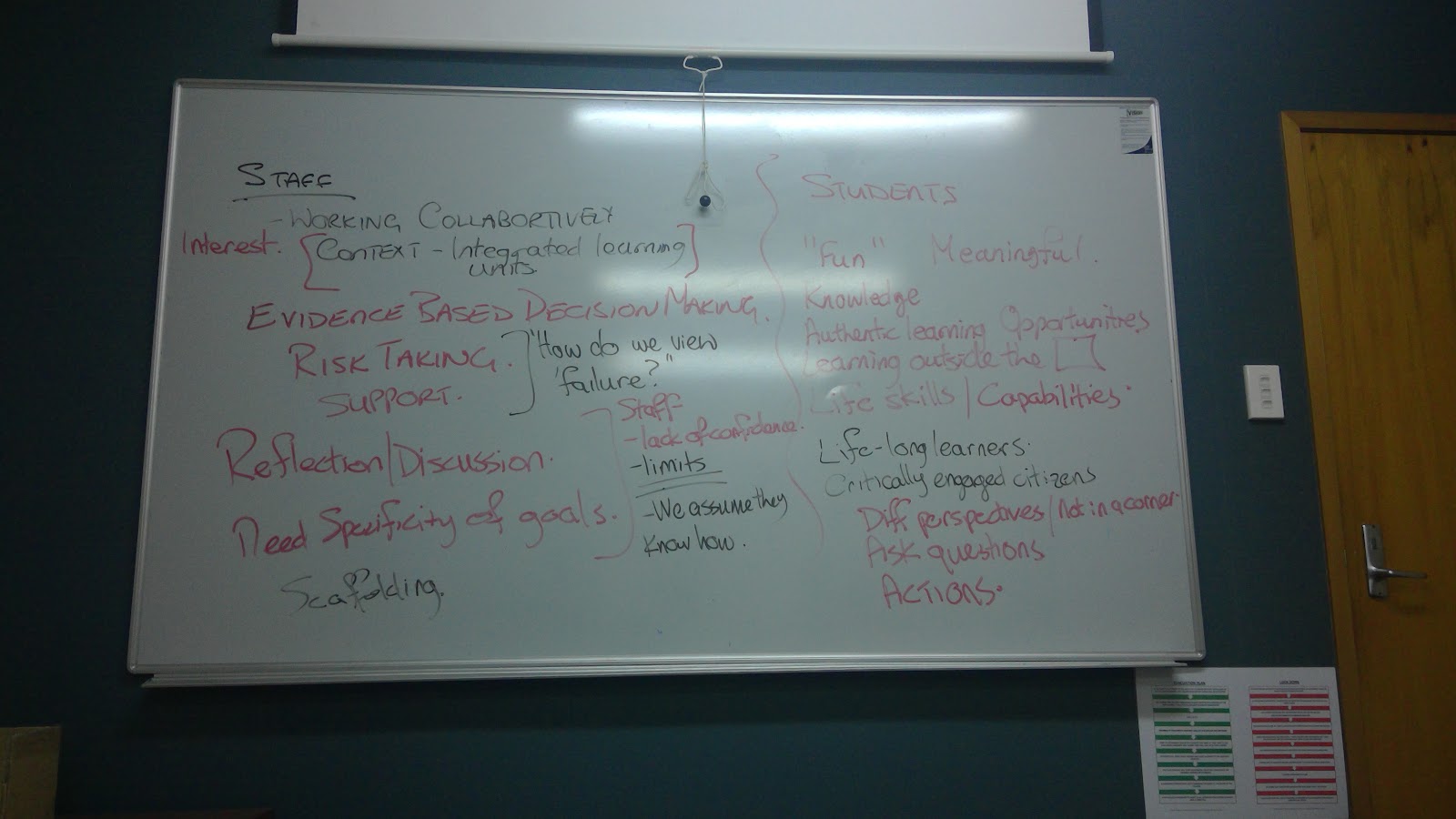
It was an interesting start to the next phase of strategic planning for an integrated unit.  The discussions were focussed around the 'big picture' of student engagement, staff involvement and community investment.

I'm looking forward to when we start getting into the nuts and bolts, and logistics about the structure of how the next integrated unit is going to be executed across the various learning areas, as well as within learning areas.

WIN_20170622_15_53_14_Pro.jpg
Share
Tweet
Pin
Share
No Comments

I spent some time working with staff in the department to apply Visible Teaching and Learning to a senior unit of work within their subject sites.  This included project instructions, learning activities, class task lists, check lists, and including hyperlinks into calendar posts.  Once the unit has been taught, we will gather student feedback to see what students have to say about accessing the learning in this way.


Share
Tweet
Pin
Share
No Comments
Older Posts

About Me

Kia ora! I am the Head of Technology at Tāmaki College and also teach Digital Technologies.


My target group of learners for my Inquiry 2021 will be my Year 12 NCEA Level 2 class. This group of learners were my target group from my 2020 Inquiry. I would like to inquire into whether Academic Writing exemplars specific to Digital Technologies, in conjunction with the 'Explanation Writing' classroom display resources for Digital Technologies, based on SOLO taxonomy, could accelerate achievement in literacy in my subject.


My target group of learners for my Inquiry 2020 were my Year 11 NCEA Level 1 class. I inquired into the process of using the LearnCoach online programs (content) and VTaL Visible Teaching and Learning (workflow) to accelerate student achievement for Tamaki College students undertaking courses in Digital Technologies NCEA Levels 1, 2 and 3.


In 2019, my inquiry is to maximise pedagogical practices (relating to integrated education, and collaborative teaching and learning), to effectively shift student achievement, supported by digital platforms connected to visible teaching and learning.


My Inquiry in 2018, was to develop a VTaL Purpose-Built Innovative Tool, to enable all elements of the VTaL Framework to be accessible to teachers, in order to accelerate student achievement.


In 2017, my inquiry was based on raising student achievement and shifting teacher practice around effective pedagogical practices including Learn, Create and Share. This will be achieved through the development, implementation and monitoring of the Visible Teaching and Learning Framework.

recent posts

Blog Archive

  • ▼  2022 (8)
    • ▼  March (3)
      • Hybrid Teaching and Learning | The impact of Omicron
      • Manaiakalani Toolkit | Well-being - Supporting Our...
      • Technology - Manaiakalani Department Discussions M...
    • ►  February (5)
  • ►  2021 (16)
    • ►  November (1)
    • ►  September (2)
    • ►  August (1)
    • ►  July (2)
    • ►  June (4)
    • ►  May (3)
    • ►  March (2)
    • ►  February (1)
  • ►  2020 (42)
    • ►  November (2)
    • ►  September (2)
    • ►  August (7)
    • ►  July (5)
    • ►  June (4)
    • ►  May (7)
    • ►  April (7)
    • ►  March (3)
    • ►  February (4)
    • ►  January (1)
  • ►  2019 (30)
    • ►  September (2)
    • ►  August (3)
    • ►  July (1)
    • ►  June (2)
    • ►  April (1)
    • ►  March (12)
    • ►  February (9)
  • ►  2018 (41)
    • ►  November (7)
    • ►  October (2)
    • ►  September (1)
    • ►  August (4)
    • ►  July (4)
    • ►  May (7)
    • ►  April (4)
    • ►  March (5)
    • ►  February (7)
  • ►  2017 (65)
    • ►  December (2)
    • ►  November (22)
    • ►  October (6)
    • ►  September (6)
    • ►  August (10)
    • ►  June (4)
    • ►  May (3)
    • ►  April (1)
    • ►  March (4)
    • ►  February (6)
    • ►  January (1)
  • ►  2016 (26)
    • ►  December (1)
    • ►  November (18)
    • ►  September (6)
    • ►  August (1)

VTaL

  • VTaL (104)
  • VTaL 01 Subject Sites (33)
  • VTaL 02 Learning Activities (7)
  • VTaL 03 Tracking Sheets (28)
  • VTaL 04 Student Checklists (12)
  • VTaL 05 Calendars with Links (24)
  • VTaL 06 Workspaces (32)
  • VTaL 07 Student Sites (4)
  • VTaL 08 Year Level Sites (3)
  • VTaL 09 Subject Communities (26)
  • VTaL 10 Student Blogs (11)
  • VTaL and Google Hangouts (15)
  • VTaL and Student Achievement (45)
  • VTaL for Parents (13)
  • VTaL for Students (82)
  • VTaL for Teachers (32)

Presentations

  • GAFE (19)
  • My YouTube Videos (8)
  • Presentations (21)

Inquiry

  • Inquiry (134)
  • Inquiry 2019 (27)
  • Inquiry 2020 (34)
  • Inquiry 2021 (15)

Manaiakalani

  • CoL (167)
  • Inquiry (134)
  • Inquiry 2020 (34)
  • Learn Create Share (11)
  • MIT 2018 (16)
  • Manaiakalani (18)
  • Presentations (21)
  • SPARK MIT (59)

Tamaki College

  • 2018 Department Goals (2)
  • 2018 School Goals (3)
  • 2019 Department Goals (2)
  • CoL (167)
  • Collaborative Learning Environments (32)
  • Covid19 (29)
  • Cultural Responsiveness (10)
  • Differentiation (12)
  • EMR Collaborative Project (21)
  • Goals (2)
  • Human Rights Collaborative Project (5)
  • Integrated Education (24)
  • Kia Eke Panuku (8)
  • LearnCoach (2)
  • Literacy (21)
  • PLD (18)
  • Techies (12)
  • Technological Modelling (4)

Practicing Teacher Criteria

  • PTC01 (31)
  • PTC02 (9)
  • PTC03 (6)
  • PTC04 (61)
  • PTC05 (17)
  • PTC06 (42)
  • PTC07 (32)
  • PTC08 (34)
  • PTC09 (8)
  • PTC10 (7)
  • PTC11 (16)
  • PTC12 (54)

General

  • CoL (167)
  • Collaborative Learning Environments (32)
  • Cultural Responsiveness (10)
  • Differentiation (12)
  • Feedback - Parent Voice (2)
  • Feedback - Staff Voice (6)
  • Feedback - Student Voice (23)
  • GAFE (19)
  • Goals (2)
  • Integrated Education (24)
  • Kia Eke Panuku (8)
  • LearnCoach (2)
  • Literacy (21)
  • My YouTube Videos (8)
  • Review (14)
  • Student Agency (15)

Contact Form

Name

Email *

Message *

Total Pageviews

Created with by BeautyTemplates| Distributed By Gooyaabi Templates