My Space and My Place

    • Home
    • Inquiry 2021
    • Digital Technologies Site
    • VTaL Site
    • VTaL G+

Marc Milford and I delivered a SLAM this morning during morning briefing, about the Literacy Strategies that we had collaborated on for my Semester/Rotation 1 Year 10 class around the context of Climate Change.

Usually I would focus a lot of class time on technical skills and techniques, in teaching the students the coding skills required for game development.  In terms of content, I would not usually allocate much learning time towards this aspect of the project.  However, for this particular project, I took some reading material and articles to Marc about Climate Change, and he helped me to break the tasks down, in order to develop the reading, discussion and writing skills with my learners, so that I could connect the students more closely to the content which they would use to develop their games.
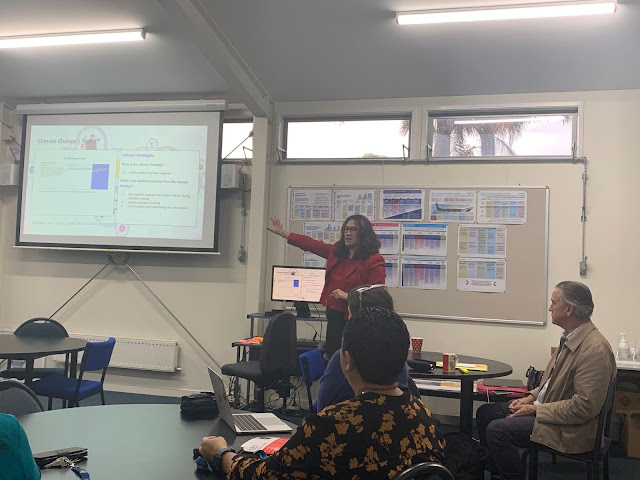


The following is the presentation slide deck that we used in the SLAM session.

Literacy Strategies - Year 10 Project | Climate Change and Game Development

It is important to note that in the process of breaking the tasks down for the learners, it wasn't a case of distributing the tasks like handouts and leaving them to navigate their way through the learning.  The students required feedback and/or feedforward so that the learning activities were useful for them, and equipped the learners to be able to write a final summary.  I used a Workspace to communicate the tasks with the learners and so that they could submit their work.  I used a tracking sheet to give students immediate feedback of the task, and used comments in their individual documents for students who needed feedforward to complete the work.

I am likely to integrate these same approaches with my target group for my 2021 CoL Inquiry this year.  Staff from other departments have shown interest in wanting to collaborate, with a particular interest in the Climate Change project, which Marc and I both welcome!


Share
Tweet
Pin
Share
No Comments


Our session began with Alex and I giving Jannie an overview of what our intention is with the collaboration between Social Studies and DigiTech with the Human Rights Project, and our ideas around using the collaboration as a platform to accelerate achievement around writing for the students.


Originally I'd thought of using AsTTLe writing data to measure progress before and after the unit of work.  However, through our discussions, Jannie emphasized the benefit of diving deep into broadening content knowledge and understanding for the students, and then focusing around what has been learnt by investigating a range of perspectives.


Within DigiTech I can still have the students develop a timeline of events that has lead to the current situation at Ihumātao, and for the students to develop this into an animated slide deck.  The slide deck can include a range of perspectives; some of which can go into depth and detail, using content taught in both Social Studies and DigiTech.  Hopefully Alex and I can go into more depth across both of our subjects by selecting a couple of perspectives each to delve into with the students.  Still thinking of ways for the students to capture this.  At this stage, I'm thinking more around the opportunities that we provide the students with to inquire into the different perspectives.  The biggest obstacle is actually class time, as I see the students 3 x lessons per week, and we've got approximately 4-5 weeks left in this semester.


A basic pre-assessment and post-assessment of knowledge and understanding about Ihumātao will hopefully give a strong enough indication of a shift for the students.  So, next steps forward is to undertake a pre-assessment exercise with the students.  Also, for Alex and I to decide on the perspectives that we'd like the students to inquire into, and the approach we will take with the students.  This will probably be the focus of our next meeting.


Share
Tweet
Pin
Share
No Comments

Leading on from our initial discussions, Alex and I met this morning to talk in more detail about broader context issues relating to Human Rights, and what the collaborative process could and would look like moving forward.

Due to the proximity of the Land Occupation at Ihumātao, Alex and I agreed that it made sense to focus on Ihumātao for the Human Rights unit, as well as it's connectedness to current day issues relating to Te Tiriti o Waitangi.

The approach that Alex and I will take is that the students will develop an animated timeline of events relating to the Land Occupation at Ihumātao for Alex, who is the students' client.  

"The animated timeline, will be used to clearly communicate to users of the outcome, a short, concise breakdown of what Ihumātao is all about.  The resource may also be used for students to form their perspectives on any breaches of human rights that are identified from the timeline."

The idea is that, through students' communicating their perspectives on any breaches of human rights, this will be the main writing segment that students' will undertake within the project.


Share
Tweet
Pin
Share
No Comments


After the initial meeting with Alex to discuss the collaboration of teaching 10TTu for the Human Rights unit of work, I decided to look at my approach to how I would be teaching both of the Year 10 classes this semester.  So, I jotted down some notes to make sense of how things would look different for each class.  

Essentially, the assessment task for DigiTech will look exactly the same, other than 10TTu having their Social Studies teacher, Mr Brown, as their client for the project.  This will enable Alex and I to stipulate specifications within the learning process, that focuses on the unit of work being used to address a social action, and also to align the content of the work with the learning that is happening in Social Studies.

Next steps are to obtain baseline data of both classes, and to investigate a summative assessment opportunity to measure against the baseline data.  This will require working with experts in the English department.
Share
Tweet
Pin
Share
No Comments
One of our Social Studies teachers, Alex Brown, and myself, had previously collaborated together on the EMR Collaborative Project early in the year.  With the changeover of our junior students from Semester 2 into Semester 3 subjects for Technology, this presented an opportunity for Alex and I to collaborate on another project with 10TTu.  So, we had an initial meeting to see how we could make this happen.  

Image result for universal declaration of human rights pdf poster

We talked about contexts relevant to the next unit of work for Social Studies; that being Human Rights.  We also discussed how the development of a digital media outcome, could be used to supplement the learning and understanding of the content relating to the context, and the possibility of the outcome also being used to address a social action relating to Human Rights.  And so, we're at the stage of sharing initial ideas and are looking at ways to expand our planning in a collaborative sense, both to engage student learning, and to accelerate achievement across both learning areas.
Share
Tweet
Pin
Share
No Comments
I had the opportunity to attend the National Enviroschools Hui.  This included a session delivered by Tai Tokerau facililator, Jacque Knight, about using cross curricular project based learning at the secondary level.


One of the Planning Processes that we undertook, included a collaboration between four different teachers, of three different schools, covering five different learning areas.  Other than myself and my colleague Dorothy, as a collective we were largely unfamiliar with working together.

Our first mission was to discuss and decide on an environmental context within our local area, that impacted the learners within our schools in some way.  We were then given a Planning Process to follow that would enable us to identify Inquiry Questions, Activity Possibilities, Resources, and then Assessment/Curriculum Links.

The Planning Process was very simplistic but very effective for collaborating.  It felt like a very natural way of discussing learning possibilities and then connecting the learning activities to assessment opportunities within specific and specialist learning areas.

I'd like to try this process with the next collaborative project that I'm involved in at school.

Share
Tweet
Pin
Share
No Comments
Older Posts

About Me

Kia ora! I am the Head of Technology at Tāmaki College and also teach Digital Technologies.


My target group of learners for my Inquiry 2021 will be my Year 12 NCEA Level 2 class. This group of learners were my target group from my 2020 Inquiry. I would like to inquire into whether Academic Writing exemplars specific to Digital Technologies, in conjunction with the 'Explanation Writing' classroom display resources for Digital Technologies, based on SOLO taxonomy, could accelerate achievement in literacy in my subject.


My target group of learners for my Inquiry 2020 were my Year 11 NCEA Level 1 class. I inquired into the process of using the LearnCoach online programs (content) and VTaL Visible Teaching and Learning (workflow) to accelerate student achievement for Tamaki College students undertaking courses in Digital Technologies NCEA Levels 1, 2 and 3.


In 2019, my inquiry is to maximise pedagogical practices (relating to integrated education, and collaborative teaching and learning), to effectively shift student achievement, supported by digital platforms connected to visible teaching and learning.


My Inquiry in 2018, was to develop a VTaL Purpose-Built Innovative Tool, to enable all elements of the VTaL Framework to be accessible to teachers, in order to accelerate student achievement.


In 2017, my inquiry was based on raising student achievement and shifting teacher practice around effective pedagogical practices including Learn, Create and Share. This will be achieved through the development, implementation and monitoring of the Visible Teaching and Learning Framework.

recent posts

Blog Archive

  • ▼  2022 (8)
    • ▼  March (3)
      • Hybrid Teaching and Learning | The impact of Omicron
      • Manaiakalani Toolkit | Well-being - Supporting Our...
      • Technology - Manaiakalani Department Discussions M...
    • ►  February (5)
  • ►  2021 (16)
    • ►  November (1)
    • ►  September (2)
    • ►  August (1)
    • ►  July (2)
    • ►  June (4)
    • ►  May (3)
    • ►  March (2)
    • ►  February (1)
  • ►  2020 (42)
    • ►  November (2)
    • ►  September (2)
    • ►  August (7)
    • ►  July (5)
    • ►  June (4)
    • ►  May (7)
    • ►  April (7)
    • ►  March (3)
    • ►  February (4)
    • ►  January (1)
  • ►  2019 (30)
    • ►  September (2)
    • ►  August (3)
    • ►  July (1)
    • ►  June (2)
    • ►  April (1)
    • ►  March (12)
    • ►  February (9)
  • ►  2018 (41)
    • ►  November (7)
    • ►  October (2)
    • ►  September (1)
    • ►  August (4)
    • ►  July (4)
    • ►  May (7)
    • ►  April (4)
    • ►  March (5)
    • ►  February (7)
  • ►  2017 (65)
    • ►  December (2)
    • ►  November (22)
    • ►  October (6)
    • ►  September (6)
    • ►  August (10)
    • ►  June (4)
    • ►  May (3)
    • ►  April (1)
    • ►  March (4)
    • ►  February (6)
    • ►  January (1)
  • ►  2016 (26)
    • ►  December (1)
    • ►  November (18)
    • ►  September (6)
    • ►  August (1)

VTaL

  • VTaL (104)
  • VTaL 01 Subject Sites (33)
  • VTaL 02 Learning Activities (7)
  • VTaL 03 Tracking Sheets (28)
  • VTaL 04 Student Checklists (12)
  • VTaL 05 Calendars with Links (24)
  • VTaL 06 Workspaces (32)
  • VTaL 07 Student Sites (4)
  • VTaL 08 Year Level Sites (3)
  • VTaL 09 Subject Communities (26)
  • VTaL 10 Student Blogs (11)
  • VTaL and Google Hangouts (15)
  • VTaL and Student Achievement (45)
  • VTaL for Parents (13)
  • VTaL for Students (82)
  • VTaL for Teachers (32)

Presentations

  • GAFE (19)
  • My YouTube Videos (8)
  • Presentations (21)

Inquiry

  • Inquiry (134)
  • Inquiry 2019 (27)
  • Inquiry 2020 (34)
  • Inquiry 2021 (15)

Manaiakalani

  • CoL (167)
  • Inquiry (134)
  • Inquiry 2020 (34)
  • Learn Create Share (11)
  • MIT 2018 (16)
  • Manaiakalani (18)
  • Presentations (21)
  • SPARK MIT (59)

Tamaki College

  • 2018 Department Goals (2)
  • 2018 School Goals (3)
  • 2019 Department Goals (2)
  • CoL (167)
  • Collaborative Learning Environments (32)
  • Covid19 (29)
  • Cultural Responsiveness (10)
  • Differentiation (12)
  • EMR Collaborative Project (21)
  • Goals (2)
  • Human Rights Collaborative Project (5)
  • Integrated Education (24)
  • Kia Eke Panuku (8)
  • LearnCoach (2)
  • Literacy (21)
  • PLD (18)
  • Techies (12)
  • Technological Modelling (4)

Practicing Teacher Criteria

  • PTC01 (31)
  • PTC02 (9)
  • PTC03 (6)
  • PTC04 (61)
  • PTC05 (17)
  • PTC06 (42)
  • PTC07 (32)
  • PTC08 (34)
  • PTC09 (8)
  • PTC10 (7)
  • PTC11 (16)
  • PTC12 (54)

General

  • CoL (167)
  • Collaborative Learning Environments (32)
  • Cultural Responsiveness (10)
  • Differentiation (12)
  • Feedback - Parent Voice (2)
  • Feedback - Staff Voice (6)
  • Feedback - Student Voice (23)
  • GAFE (19)
  • Goals (2)
  • Integrated Education (24)
  • Kia Eke Panuku (8)
  • LearnCoach (2)
  • Literacy (21)
  • My YouTube Videos (8)
  • Review (14)
  • Student Agency (15)

Contact Form

Name

Email *

Message *

Total Pageviews

Created with by BeautyTemplates| Distributed By Gooyaabi Templates