My Space and My Place

    • Home
    • Inquiry 2021
    • Digital Technologies Site
    • VTaL Site
    • VTaL G+
What’s the Big Idea for 2018

“Language in Abundance”, Language Acquisition, development, Transfer and sustaining across school levels and curriculum domains.


Language in abundance environments ‘drip’ with language availability
and attention, where noticing and relevant use of words allow for
deeper, wider, more specific and precise, context appropriate
language expression…leading to knowing at deeper and broader
levels. Dr. Jannie Van Hees

At the beginning of the year, when we first started discussing what the CoL focus would be for 2018, and with me already a year into my CoL inquiry, I was unsure as to how to connect "Language in Abundance"with my existing inquiry findings.   Not because what I was inquiring into was irrelevant to the concept of "Language in Abundance", but because my inquiry was and is focused around a framework; so essentially, a collective range of individual components and processes to enable accelerated achievement to take place.

My approach to addressing literacy for students within my inquiry process, focused more on the literacy associated with visibility and clarity of learning information for the students, as opposed to the literacy strategies for students.  This is reiterated in some of the Manaiakalani Inquiries presentation materials delivered by Rebecca Jesson, as shown in the image below "Are the instructions/ways to participate clear?"


Visibility and Clarity of Instructions

Some of the research materials that I'd been looking at with regards to visibility and clarity of learning information includes the following:

  • Instructions https://goo.gl/bqk4Ap
  • How to Write Clear Instructions https://goo.gl/StVytd
  • Making Learning Visible https://goo.gl/TjXUP5

In terms of 'Instructions', useful take-outs from this resource link includes the purpose of instructions, as well as the features of instructions:


In terms of writing clear instructions, this research link focussed on three key areas:

  1. Understanding the Task
  2. Writing Your Instructions
  3. Testing Your Instructions

This year I have been extensively trialing the use of Workspaces to communicate learning information to students, as well as collate evidence of student learning in order to provide students with both formative and summative feedback on learning tasks.  The trialing of the Workspaces is in comparison to the sole use of learning instructions that are embedded, linked and accessible to students via my Subject Google Site.

My next steps for further investigating the Literacy Lens of my Inquiry, is to identify the pros and cons of the use of Workspaces v my Subject Google Site, in terms of which resource (if either) is more effective in enabling visibility and clarity of instructions for students.
Share
Tweet
Pin
Share
No Comments

Achievement Challenge

My Inquiry for 2018 will extend from my 2017 Inquiry, and relates to the Manaiakalani  CoL Achievement Challenge 1.

Achievement Challenge 1 : To raise Māori student achievement through the development of cultural visibility and responsive practices across the pathway as measured against National Standards and agreed targets for reading Years 1-10 and NCEA years 11-13.

Inquiry 2018

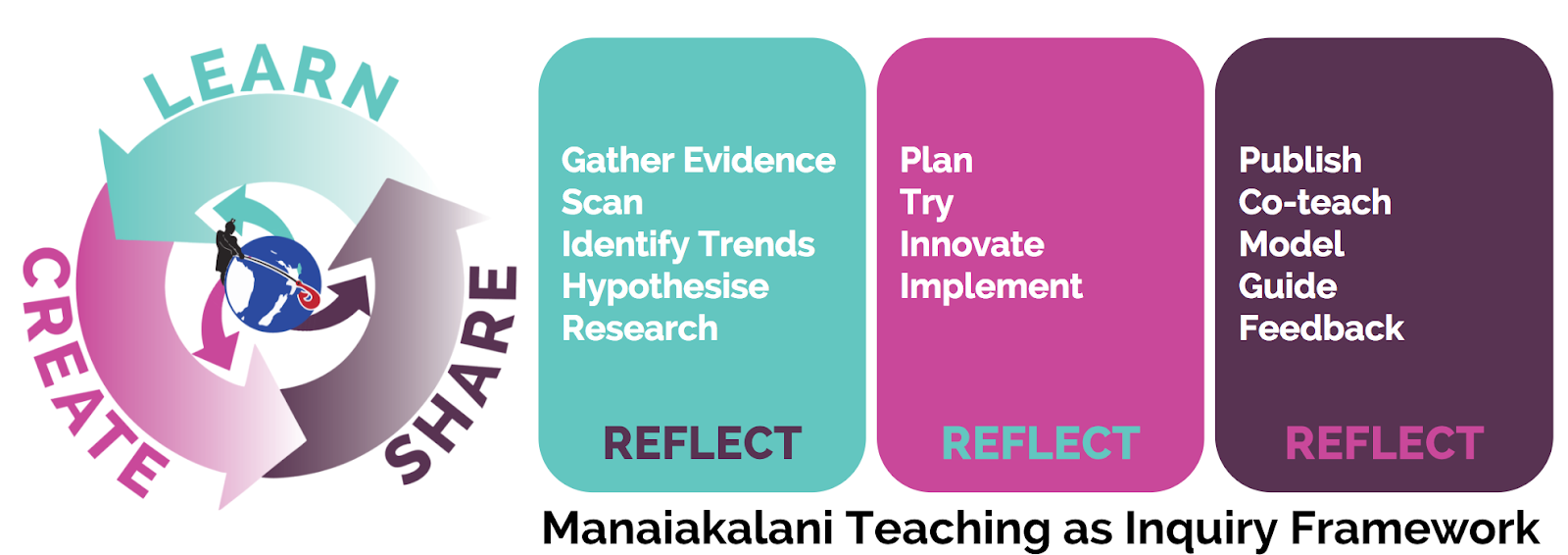
In 2018, my inquiry will be based on raising student achievement and shifting teacher practice around effective pedagogical practices including Learn, Create and Share. This will be achieved through the development, implementation and monitoring of the Visible Teaching and Learning Framework. This will involve further development and refinement of digital tools within the framework, to enable sustainable and effective pedagogical practices to occur, that positively impacts on student achievement.


Thanks to Karen Ferguson for the graphic design.


Manaiakalani CoL : Teaching Inquiry Framework

Manaiakalani CoL : Teaching Inquiry Framework Template


Share
Tweet
Pin
Share
No Comments

SC65400559 15073006350.jpg

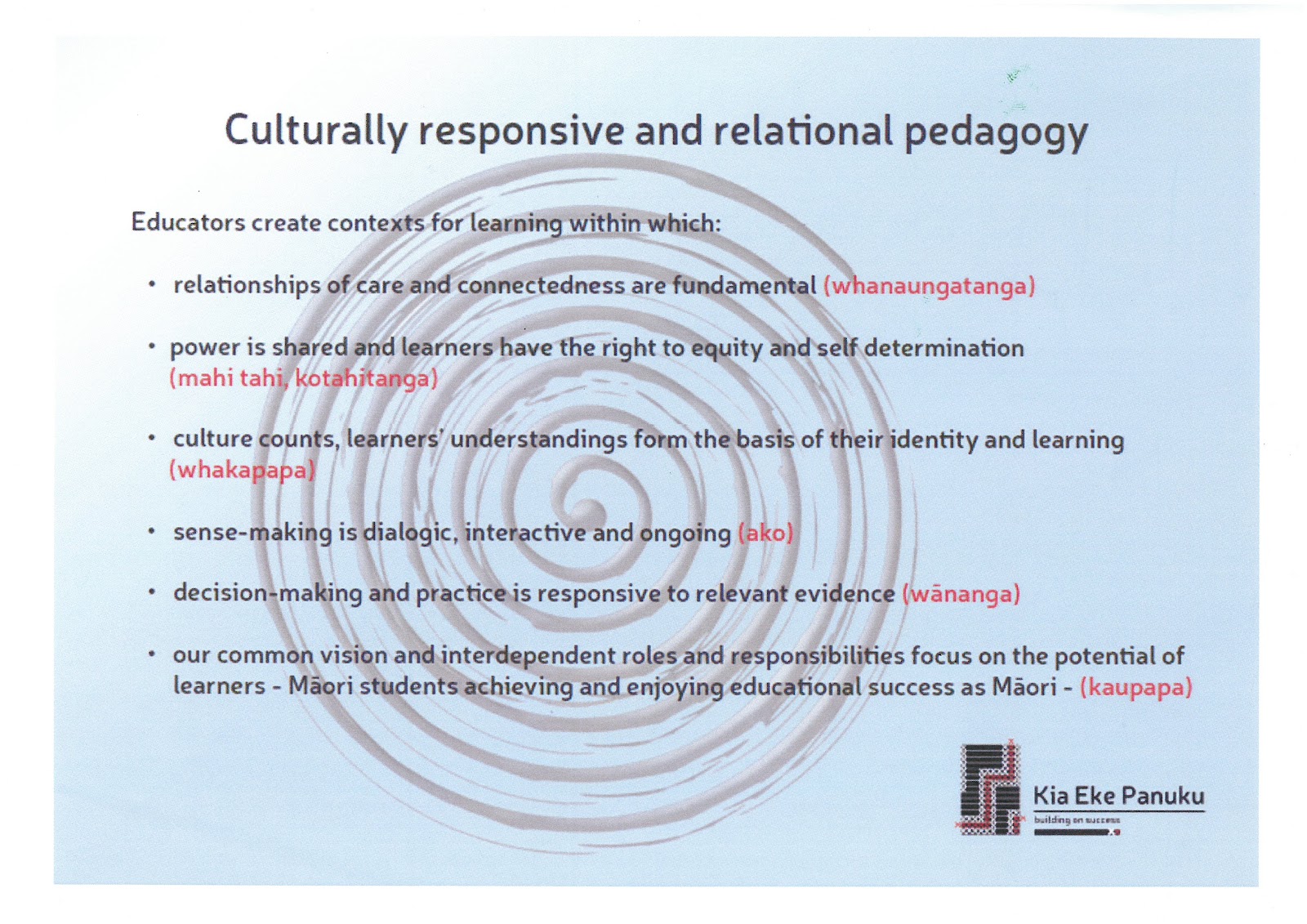
The following are some examples of how various aspects of VTaL may be utilised and align with contexts of Culturally Responsive and Relational Pedagogy.  The examples below are embedded within the unit plan that I will be delivering during JumpStart this year, 11DGT Create a Web Page US18734.

Whanaungatanga - Where relationships of care and connectedness are fundamental.
Collaborative Learning Opportunities are provided for students:
  • Class discussions about context ideas
  • Sharing completed tasks in Google+ as a tool to guide the learning of others
  • +1 and Commenting on tasks shared in Google+
  • Peer feedback in Evaluations

Mahi Tahi Kotahitanga - Where power is shared and learners have the right to self-determination.
Empowerment for students:
  • Students can use Student Check Lists to track their own progress within this unit of work
  • Wananga between kaiako-tauira to select standards according to their interest in IT and DigiTech.  The standards available in DigiTech can be located within the DigiTech site under each NCEA Level (Assessment Information, and, Overview and Calendar)

Ako - Where learning is interactive and spirals.
Ako is interactive and spirals in terms of learning workflow, by applying the following in the learning process:
  • Year Level Calendar, Project Instructions, Learning Activities, and Student Progress (Class Task Lists and Student Checklists) are embedded in the Subject Google Site, and visible to learners
  • Year Level Calendar with Hyperlinked Learning Activities communicates the focus for the lesson each day and is a rewindable resource
  • Project Instructions communicates the big picture of the project to students
  • Learning Activities communicates the individual task requirements to students
  • Student Progress (Class Task Lists) communicates to students where students are tracking at with regards to task completion towards completing the overall standard
  • Communities provides examples of work to guide learning

Wananga - Decision-making and practice in response to relevant evidence.
Kaiako-Tauira Wananga are provided for students:
  • Use Class Task Lists and Student Check Lists to have discussions around progress and support for developing learning
  • Wananga between kaiako-tauira to select standards according to their interest in IT and DigiTech.  The standards available in DigiTech can be located within the DigiTech site under each NCEA Level (Assessment Information, and, Overview and Calendar)

Share
Tweet
Pin
Share
No Comments


Image result for unit plan


The unit of work that I am delivering for the JumpStart program in Term 4 is 11DGT Create a Web Page US18734.  The unit plan itself shows the extent to which VTaL Visible Teaching and Learning can be integrated into all aspects of learning within the unit of work.  The unit plan template has been developed by Middle Leaders in consultation with the Senior Leadership Team, Curriculum Committee and Teaching Staff, to encapsulate aspects of the Curriculum.

The following are sections of the unit plan that applies various components of VTaL Visible Teaching and Learning:
  • Teaching and Learning - Learning Activities, Resources
  • Assessment - Prior Assessment, Formative Assessment, Summative Assessment
  • RISE Values - Respect, Integrity, Success, Responsibility
  • NZC Key Competencies - Thinking, Relating to Others, Understanding Language, Symbols and Text, Managing Self, Participating and Contributing
  • SAMR - Redefinition
  • NZC Literacy and Numeracy - Literacy
  • SOLO Taxonomy - Unistructural (Identify), Multistructural (Describe), Relational (Apply), Extended Abstract (Evaluate)
  • Differentiation - Process, Learning Environment
  • Kia Eke Panuku - Whanaungatanga, Mahi Tahi Kotahitanga, Wananga
  • Career Management Competencies - Exploring Opportunities, Deciding and Acting

Share
Tweet
Pin
Share
No Comments


I delivered this presentation to staff during Te Wiki o te Reo Māori, to outline ways in which staff could apply cultural responsiveness with regards to pronouncing student names correctly.  Whilst the presentation was delivered during Māori Language Week, the concepts around cultural responsiveness apply to students, staff and whānau of any background or ethnicity.


Share
Tweet
Pin
Share
No Comments
Older Posts

About Me

Kia ora! I am the Head of Technology at Tāmaki College and also teach Digital Technologies.


My target group of learners for my Inquiry 2021 will be my Year 12 NCEA Level 2 class. This group of learners were my target group from my 2020 Inquiry. I would like to inquire into whether Academic Writing exemplars specific to Digital Technologies, in conjunction with the 'Explanation Writing' classroom display resources for Digital Technologies, based on SOLO taxonomy, could accelerate achievement in literacy in my subject.


My target group of learners for my Inquiry 2020 were my Year 11 NCEA Level 1 class. I inquired into the process of using the LearnCoach online programs (content) and VTaL Visible Teaching and Learning (workflow) to accelerate student achievement for Tamaki College students undertaking courses in Digital Technologies NCEA Levels 1, 2 and 3.


In 2019, my inquiry is to maximise pedagogical practices (relating to integrated education, and collaborative teaching and learning), to effectively shift student achievement, supported by digital platforms connected to visible teaching and learning.


My Inquiry in 2018, was to develop a VTaL Purpose-Built Innovative Tool, to enable all elements of the VTaL Framework to be accessible to teachers, in order to accelerate student achievement.


In 2017, my inquiry was based on raising student achievement and shifting teacher practice around effective pedagogical practices including Learn, Create and Share. This will be achieved through the development, implementation and monitoring of the Visible Teaching and Learning Framework.

recent posts

Blog Archive

  • ▼  2022 (8)
    • ▼  March (3)
      • Hybrid Teaching and Learning | The impact of Omicron
      • Manaiakalani Toolkit | Well-being - Supporting Our...
      • Technology - Manaiakalani Department Discussions M...
    • ►  February (5)
  • ►  2021 (16)
    • ►  November (1)
    • ►  September (2)
    • ►  August (1)
    • ►  July (2)
    • ►  June (4)
    • ►  May (3)
    • ►  March (2)
    • ►  February (1)
  • ►  2020 (42)
    • ►  November (2)
    • ►  September (2)
    • ►  August (7)
    • ►  July (5)
    • ►  June (4)
    • ►  May (7)
    • ►  April (7)
    • ►  March (3)
    • ►  February (4)
    • ►  January (1)
  • ►  2019 (30)
    • ►  September (2)
    • ►  August (3)
    • ►  July (1)
    • ►  June (2)
    • ►  April (1)
    • ►  March (12)
    • ►  February (9)
  • ►  2018 (41)
    • ►  November (7)
    • ►  October (2)
    • ►  September (1)
    • ►  August (4)
    • ►  July (4)
    • ►  May (7)
    • ►  April (4)
    • ►  March (5)
    • ►  February (7)
  • ►  2017 (65)
    • ►  December (2)
    • ►  November (22)
    • ►  October (6)
    • ►  September (6)
    • ►  August (10)
    • ►  June (4)
    • ►  May (3)
    • ►  April (1)
    • ►  March (4)
    • ►  February (6)
    • ►  January (1)
  • ►  2016 (26)
    • ►  December (1)
    • ►  November (18)
    • ►  September (6)
    • ►  August (1)

VTaL

  • VTaL (104)
  • VTaL 01 Subject Sites (33)
  • VTaL 02 Learning Activities (7)
  • VTaL 03 Tracking Sheets (28)
  • VTaL 04 Student Checklists (12)
  • VTaL 05 Calendars with Links (24)
  • VTaL 06 Workspaces (32)
  • VTaL 07 Student Sites (4)
  • VTaL 08 Year Level Sites (3)
  • VTaL 09 Subject Communities (26)
  • VTaL 10 Student Blogs (11)
  • VTaL and Google Hangouts (15)
  • VTaL and Student Achievement (45)
  • VTaL for Parents (13)
  • VTaL for Students (82)
  • VTaL for Teachers (32)

Presentations

  • GAFE (19)
  • My YouTube Videos (8)
  • Presentations (21)

Inquiry

  • Inquiry (134)
  • Inquiry 2019 (27)
  • Inquiry 2020 (34)
  • Inquiry 2021 (15)

Manaiakalani

  • CoL (167)
  • Inquiry (134)
  • Inquiry 2020 (34)
  • Learn Create Share (11)
  • MIT 2018 (16)
  • Manaiakalani (18)
  • Presentations (21)
  • SPARK MIT (59)

Tamaki College

  • 2018 Department Goals (2)
  • 2018 School Goals (3)
  • 2019 Department Goals (2)
  • CoL (167)
  • Collaborative Learning Environments (32)
  • Covid19 (29)
  • Cultural Responsiveness (10)
  • Differentiation (12)
  • EMR Collaborative Project (21)
  • Goals (2)
  • Human Rights Collaborative Project (5)
  • Integrated Education (24)
  • Kia Eke Panuku (8)
  • LearnCoach (2)
  • Literacy (21)
  • PLD (18)
  • Techies (12)
  • Technological Modelling (4)

Practicing Teacher Criteria

  • PTC01 (31)
  • PTC02 (9)
  • PTC03 (6)
  • PTC04 (61)
  • PTC05 (17)
  • PTC06 (42)
  • PTC07 (32)
  • PTC08 (34)
  • PTC09 (8)
  • PTC10 (7)
  • PTC11 (16)
  • PTC12 (54)

General

  • CoL (167)
  • Collaborative Learning Environments (32)
  • Cultural Responsiveness (10)
  • Differentiation (12)
  • Feedback - Parent Voice (2)
  • Feedback - Staff Voice (6)
  • Feedback - Student Voice (23)
  • GAFE (19)
  • Goals (2)
  • Integrated Education (24)
  • Kia Eke Panuku (8)
  • LearnCoach (2)
  • Literacy (21)
  • My YouTube Videos (8)
  • Review (14)
  • Student Agency (15)

Contact Form

Name

Email *

Message *

Total Pageviews

Created with by BeautyTemplates| Distributed By Gooyaabi Templates