My Space and My Place

    • Home
    • Inquiry 2021
    • Digital Technologies Site
    • VTaL Site
    • VTaL G+

Initially, the inquiry idea that I had for 2020 is that I would focus on the target group of my combined NCEA Level 2 and Level 3 students. 

The desired change in student learning that wanted to inquiry into was 'Whether increased and sustained engagement leading to achievement, could occur via the combination of online tutorials for learning (skills and content specific to NCEA standards), and Hapara Workspaces for resource sharing, evidence gathering, tracking and monitoring of student achievement'. 

The reason that I wanted to focus on NCEA Level 2 and Level 3 students is because this was the target group that these students are most closely connected to school leaving age, and the goal of '18-year-olds having a minimum of NCEA Level 2 or equivalent'.


Collaborate with Colleagues

On Monday 2 March during our Curriculum Committee meeting of School Leaders at Tamaki College, the focus was to discuss within our smaller groups (which included Christine David from Maths, Elenoa Telenoa from Art and myself), theories of action to address the achievement of Year 11 students in 2020.

The following are discussion and reflection points that I had regarding the students in my Year 11 DigiTech class this year.


It dawned on me through this discussion process that actually my target group for my Inquiry 2020 would actually be best suited to be my Year 11 NCEA Level 1 class.  If I was already having discussions with colleagues about this group of students, and this would be an ongoing discussion throughout the year, then it just made sense.  Christine and I met again the following Monday, 9 March after school, to see where we were at with the suggestions that we'd discussed from our curriculum meeting.  I'd applied the first suggestion highlighted in pink, and was looking forward to the PD session with LearnCoach on Tuesday 10th March.

Collaborate with Senior Leadership Team

On Thursday 12th March, the Tamaki College CoL teachers (including myself) met with Soana, Russel and Kathryn to discuss our inquiry ideas.  The idea that I shared my inquiry was 'Will the use of online tutorials (for content knowledge) lift achievement in NCEA Digital Technologies?' with the target group being my NCEA Level 1 students.  I conveyed to the group that I'd been tossing between my target group being my NCEA Level 2/3 students, or, being my NCEA Level 1 students.  The rationale for refocussing to my NCEA Level 1 students was that:

  • the target group aligns with the focus for the Collaborative Leadership approach with Middle Leaders in Curriculum Committee
  • LearnCoach materials are available for Level 1 courses
  • the overall inquiry idea relates to School Goal 1 - To raise Maori achievement and cultural visibility
Feedback from the meeting included the following:
  • focussing on NCEA Level 1 will allow a carry through into 2021
  • upskilling in Digital Technologies content and knowledge at NCEA level could provide an example of managing change (unpacking and resourcing) across any learning areas when the new NCEA standards are introduced
  • consideration of who I'm collaborating with to support my inquiry idea

Based on the conversations and feedback from colleagues and SLT, I'm relatively confident that the target group of NCEA Level 1 DigiTech students is a sensible group to focus on, and that my inquiry will make a powerful contribution to wider school and cluster goals.




Share
Tweet
Pin
Share
6 Comments

Create a Website 
NCEA Level 2


The following are a set of teaching and learning materials that were used for
my NCEA Level 2 Class to create a website from a given brief.

Project Instruction

The project instructions includes a brief, specifications, tasks, assessment criteria
and a student checklist to enable students to complete the task.
  • Create a Website : Project Instructions http://bit.ly/39Y1pQg 

Student Work

The following are a couple of examples of student work that the students
handed in for this project.
  • Gustavo Pohatu http://bit.ly/2U35hZE 
  • Lisiate Pau’uvale http://bit.ly/2W7zzNy 

Digital Media Outcome - Websites

The following are a couple of examples of outcomes completed by the student.
    • Gustavo Pohatu - Website http://bit.ly/2TKZIQN 
    • Lisiate Pau’uvale - Website http://bit.ly/2Q89c6w 


    Share
    Tweet
    Pin
    Share
    2 Comments
    The following is a breakdown of the Level 2 students undertaking Digital Technologies in 2020, who were identified as Priority Learners in 2019 as Year 11 Students.

    Subject
    No. of Students
    No. with >80
    No. of Maori
    No. of Maori >80
    201DGT An
    9
    7
    2
    1

    The table above shows that 7 out of 9 students gained less than 80 Level 1 credits in 2019 across all of their subjects.

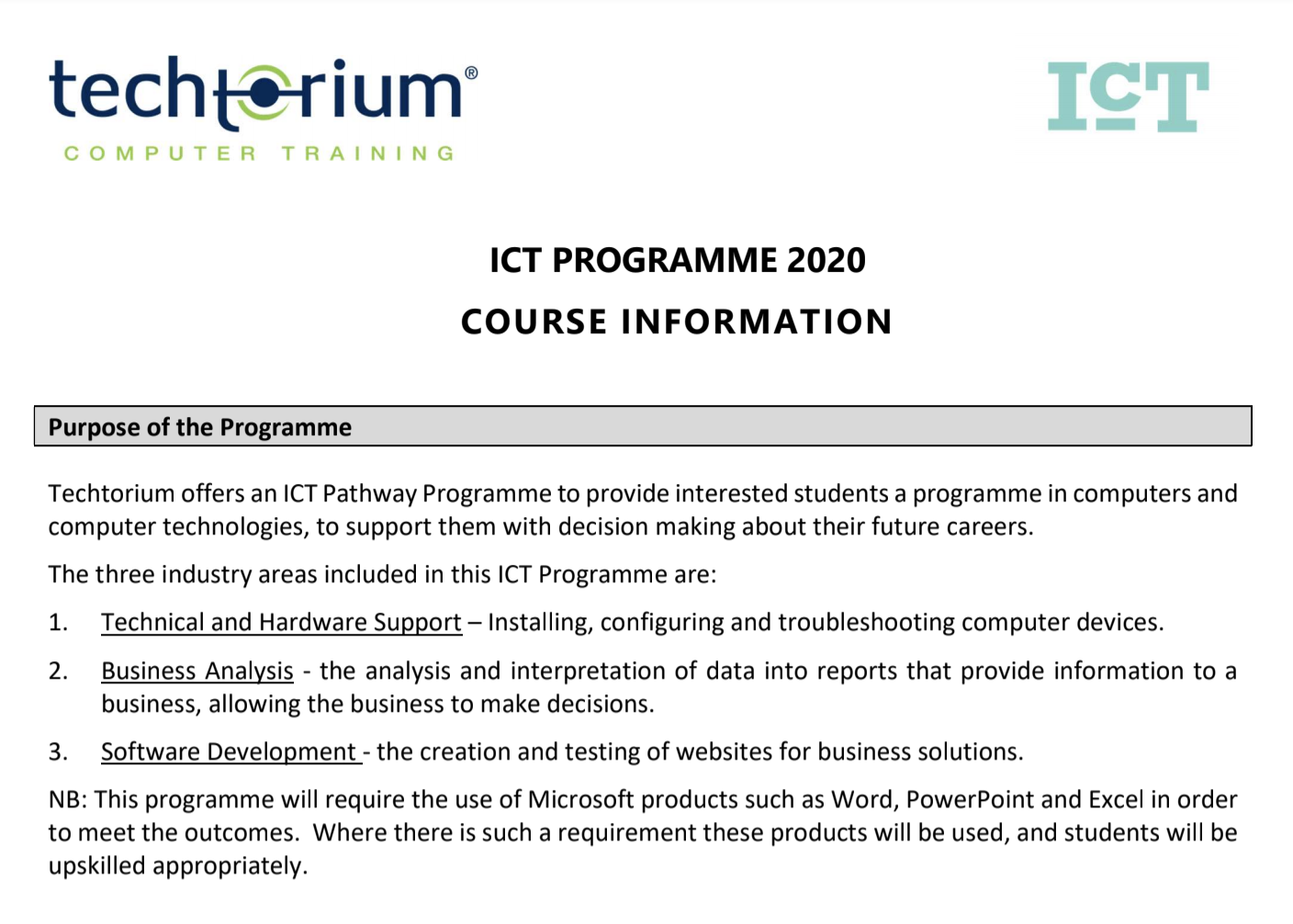
    The primary intervention that I have put in place to support these learners is by enrolling the students into the Techtorium ICT Program for 2020 under the Trades Academy. The ICT Program means that the students attend Techtorium one day per week over the course of the year, with the potential of gaining 30 Level 2 unit standards that contribute towards their NCEA Level 2 and Level 1 qualifications.


    Attending Techtorium gives the students the opportunity to experience a tertiary learning environment outside of their regular learning programs, which is often an awesome way of engaging learners who may (for any number of reasons), not be achieving within the normal onsite programs.

    This week is the first week that the Level 2 students attended the Techtorium course, and the feedback from students was that the course was fantastic and they can’t wait until next week!  Long may this level of enthusiasm and engagement last.
    Share
    Tweet
    Pin
    Share
    No Comments

    At the beginning of each year once subject selection has been finalised, is when our class lists are locked in and we get to know who our students are in our senior subjects. Generally we already have an idea from the previous year, but often there are multiple changes that take place, and our classes are firmed up by about week 2 or 3.


    This year is no different to any other with my Level 2 and 3 DigiTech class, in that it is multi-level, and includes a mix of students who have not taken DigiTech in Level 1, or Level 2, or in some cases are taking DigiTech for the first time in NCEA Level 3 only having previously taken the subject as a short course in Year 9 or 10. 


    The following includes information about my NCEA Level 2 and NCEA Level 3 classes.  The yellow highlighted sections signify learners who have not taken DigiTech in the previous year levels, and are undertaking NCEA Digital Technologies for the first time in 2020.

    The breakdown of my NCEA Level 2 class is as follows: 


    Within the NCEA Level 2 cohort, two of the students are new to New Zealand and new to the NCEA education system. 

    The breakdown of my NCEA Level 3 class is as follows: 

    Career Pathways 

    One of the first activities that I asked the students to undertake, was to identify where they are at now, where they seeing themselves tracking to next year, and knowing the standards that they would be undertaking during DigiTech this year. This was to give the students a starting point, a goal post to aim towards, and also that I would have an idea of what their aspirations are in terms of their career pathways. 

    The following is an example of the Career Pathways task:


    Share
    Tweet
    Pin
    Share
    No Comments

    My recent and ongoing involvement as a Panel member for LearnCoach, a NZ start-up company who develops NCEA videos and resources for students and schools, has involved collaborating with IT professionals to develop online resources that enables learners to achieve credits from the Digital Technologies curriculum.


    I intend using the LearnCoach online programs to accelerate student achievement for Tamaki College students undertaking courses in Digital Technologies NCEA Levels 1, 2 and 3.

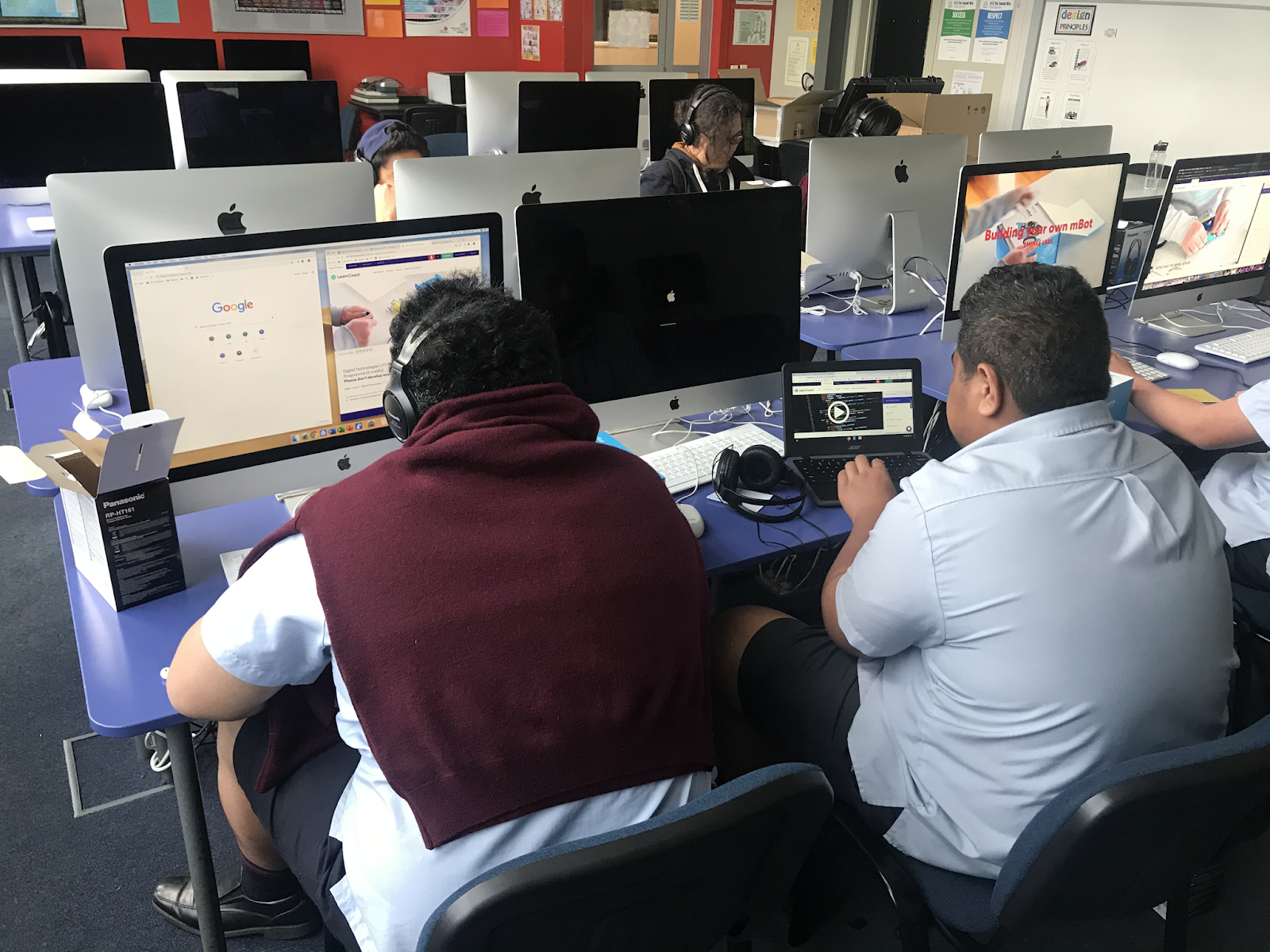
    During JumpStart 2019, I managed to trial some of the online LearnCoach tutorials with my NCEA Level 1 class. I developed a Workspace so that the students could capture the work that they had been completing on the LearnCoach site. The purpose of the Workspace was so that students could submit individual tasks relating to various sections of the module, and I could provide the students with formative feedback as well as track student progress. The Workspace was also designed to give the students who essentially were transitioning out of Year 10 and into the senior school, insight into the evidence that they have to provide, to demonstrate their knowledge and understanding when undertaking NCEA standards.

    The students found the work to be extremely engaging. The students were already familiar with using Workspaces in my class for completing and submitting work, as well as tracking their achievement. Accessing learning activities through the LearnCoach site, was a new experience for the learners. They enjoyed being able to undertake learning activities that involved a mix of audio/visual video modules, developing codes to perform tasks, and testing their codes which they recorded using PhotoBooth on the Mac machines.

    Here is an example of a slide deck that one of the students submitted into the Workspace:


    Based on the impact of trialing the LearnCoach resources during the JumpStart 2019 program with my NCEA Level 1 class, I am keen to utilise the LearnCoach modules for all of my NCEA Levels 1, 2 and 3 students in 2020.


    Share
    Tweet
    Pin
    Share
    No Comments

    I would like to integrate my knowledge of the Digital Technologies curriculum to support schools to deliver programs in alignment with the new digital technologies progress outcomes.

    I would like to use the content knowledge and understanding that I have from my involvement on the LearnCoach Panel, and from delivering the Digital Technologies programs to Tamaki College students, to support planning that enables learners in Year 7-10 to develop their understanding of digital technologies terminology and content knowledge in preparation for NCEA.

    I believe this can be achieved by refining courses and programs in readiness for the new Digital Technologies curriculum, that are easily accessible to learners, and that supports accelerated achievement for learners within the Manaiakalani Cluster and Outreach schools. This includes teaching and learning programs that enable:

    • Access to all learning resources 
    • Access to regular formative feedback 
    • Access to representations of student work that creatively demonstrates understanding of learning 

    The following is the mBoT and Robotics Unit Plan that Russel asked me to put together for when Bucklands Beach Intermediate visited Tamaki College last year to observe how the Digital Technologies was being implemented within the Year 7 and 8 program. It's based off the learning activities that Russel had planned for Year 7 and 8 last year.  The Unit Plan includes links to the Digital Technologies Curriculum, links to Assessment and Reporting, as well as information relating to Teaching and Learning.  The Unit Plan is a starting point for planning, as well as reviewing the teaching and learning.


    Nilesh Krishna is one of our Maths teachers, who also teaches Robotics to Year 7 and 8, and is teaching some of the students from Panmure Bridge while Bucklands Beach was visiting.


    Share
    Tweet
    Pin
    Share
    No Comments
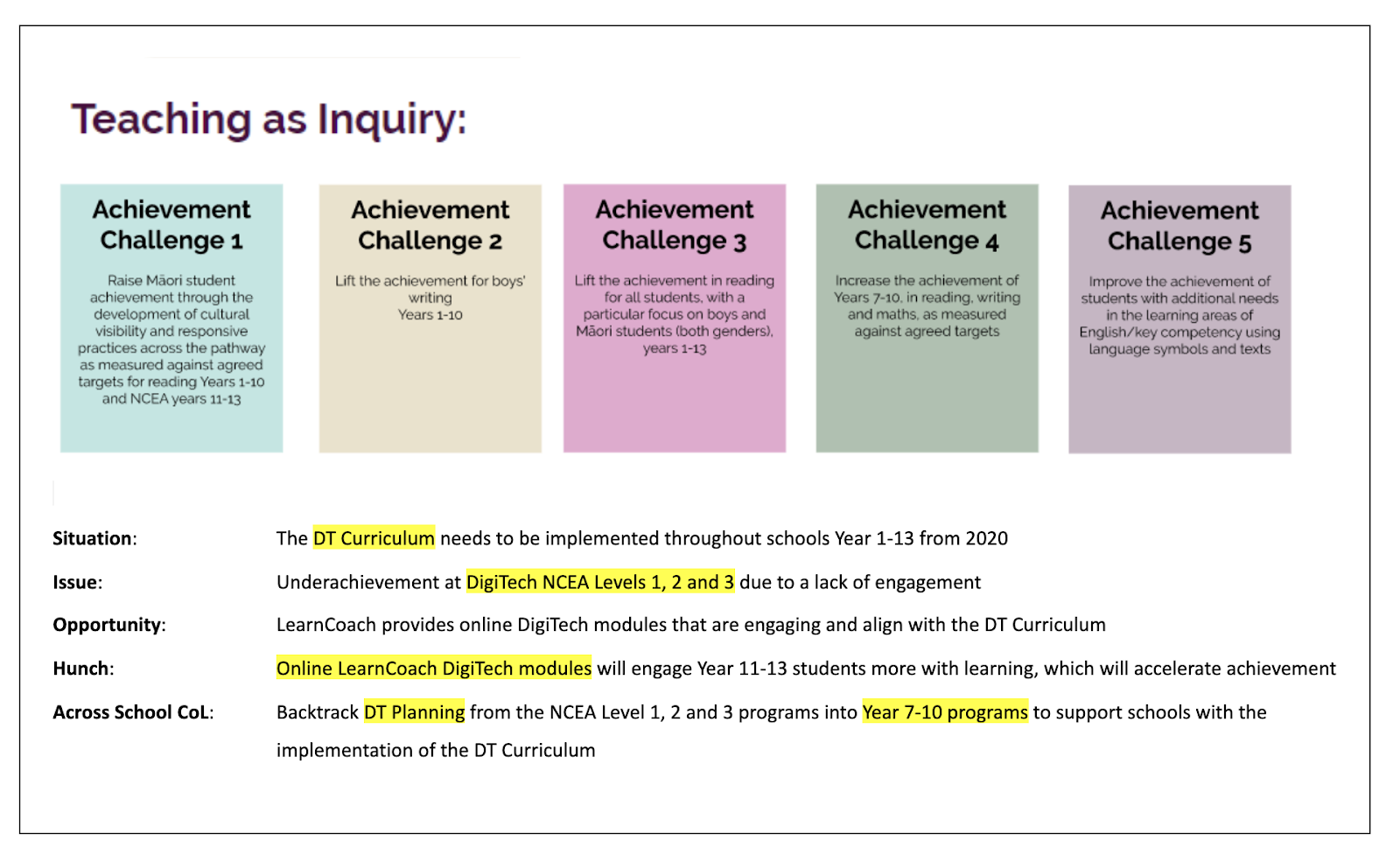
    As a part of my Community of Learning (CoL) role, my focus for 2020 is developing digitally literate learners who are capable of entering into the IT industry. As the Head of Technology, and Teacher of Digital Technologies at Tamaki College, I have delivered teaching and learning programs to Year 7 to Year 13 students from the Technology Curriculum, and am involved in transitioning students through the learning process associated with delivering the new Digital Technologies Curriculum. My inquiry will be focussed around my NCEA Level 2 and 3 students. The hunch that I have is that the online LearnCoach DigiTech modules that I intend using with my learners, will engage Year 11-13 students more with learning, which will accelerate achievement.

    The following is an overview of my Inquiry for 2020.
    Share
    Tweet
    Pin
    Share
    No Comments
    Newer Posts
    Older Posts

    About Me

    Kia ora! I am the Head of Technology at Tāmaki College and also teach Digital Technologies.


    My target group of learners for my Inquiry 2021 will be my Year 12 NCEA Level 2 class. This group of learners were my target group from my 2020 Inquiry. I would like to inquire into whether Academic Writing exemplars specific to Digital Technologies, in conjunction with the 'Explanation Writing' classroom display resources for Digital Technologies, based on SOLO taxonomy, could accelerate achievement in literacy in my subject.


    My target group of learners for my Inquiry 2020 were my Year 11 NCEA Level 1 class. I inquired into the process of using the LearnCoach online programs (content) and VTaL Visible Teaching and Learning (workflow) to accelerate student achievement for Tamaki College students undertaking courses in Digital Technologies NCEA Levels 1, 2 and 3.


    In 2019, my inquiry is to maximise pedagogical practices (relating to integrated education, and collaborative teaching and learning), to effectively shift student achievement, supported by digital platforms connected to visible teaching and learning.


    My Inquiry in 2018, was to develop a VTaL Purpose-Built Innovative Tool, to enable all elements of the VTaL Framework to be accessible to teachers, in order to accelerate student achievement.


    In 2017, my inquiry was based on raising student achievement and shifting teacher practice around effective pedagogical practices including Learn, Create and Share. This will be achieved through the development, implementation and monitoring of the Visible Teaching and Learning Framework.

    recent posts

    Blog Archive

    • ▼  2022 (8)
      • ▼  March (3)
        • Hybrid Teaching and Learning | The impact of Omicron
        • Manaiakalani Toolkit | Well-being - Supporting Our...
        • Technology - Manaiakalani Department Discussions M...
      • ►  February (5)
    • ►  2021 (16)
      • ►  November (1)
      • ►  September (2)
      • ►  August (1)
      • ►  July (2)
      • ►  June (4)
      • ►  May (3)
      • ►  March (2)
      • ►  February (1)
    • ►  2020 (42)
      • ►  November (2)
      • ►  September (2)
      • ►  August (7)
      • ►  July (5)
      • ►  June (4)
      • ►  May (7)
      • ►  April (7)
      • ►  March (3)
      • ►  February (4)
      • ►  January (1)
    • ►  2019 (30)
      • ►  September (2)
      • ►  August (3)
      • ►  July (1)
      • ►  June (2)
      • ►  April (1)
      • ►  March (12)
      • ►  February (9)
    • ►  2018 (41)
      • ►  November (7)
      • ►  October (2)
      • ►  September (1)
      • ►  August (4)
      • ►  July (4)
      • ►  May (7)
      • ►  April (4)
      • ►  March (5)
      • ►  February (7)
    • ►  2017 (65)
      • ►  December (2)
      • ►  November (22)
      • ►  October (6)
      • ►  September (6)
      • ►  August (10)
      • ►  June (4)
      • ►  May (3)
      • ►  April (1)
      • ►  March (4)
      • ►  February (6)
      • ►  January (1)
    • ►  2016 (26)
      • ►  December (1)
      • ►  November (18)
      • ►  September (6)
      • ►  August (1)

    VTaL

    • VTaL (104)
    • VTaL 01 Subject Sites (33)
    • VTaL 02 Learning Activities (7)
    • VTaL 03 Tracking Sheets (28)
    • VTaL 04 Student Checklists (12)
    • VTaL 05 Calendars with Links (24)
    • VTaL 06 Workspaces (32)
    • VTaL 07 Student Sites (4)
    • VTaL 08 Year Level Sites (3)
    • VTaL 09 Subject Communities (26)
    • VTaL 10 Student Blogs (11)
    • VTaL and Google Hangouts (15)
    • VTaL and Student Achievement (45)
    • VTaL for Parents (13)
    • VTaL for Students (82)
    • VTaL for Teachers (32)

    Presentations

    • GAFE (19)
    • My YouTube Videos (8)
    • Presentations (21)

    Inquiry

    • Inquiry (134)
    • Inquiry 2019 (27)
    • Inquiry 2020 (34)
    • Inquiry 2021 (15)

    Manaiakalani

    • CoL (167)
    • Inquiry (134)
    • Inquiry 2020 (34)
    • Learn Create Share (11)
    • MIT 2018 (16)
    • Manaiakalani (18)
    • Presentations (21)
    • SPARK MIT (59)

    Tamaki College

    • 2018 Department Goals (2)
    • 2018 School Goals (3)
    • 2019 Department Goals (2)
    • CoL (167)
    • Collaborative Learning Environments (32)
    • Covid19 (29)
    • Cultural Responsiveness (10)
    • Differentiation (12)
    • EMR Collaborative Project (21)
    • Goals (2)
    • Human Rights Collaborative Project (5)
    • Integrated Education (24)
    • Kia Eke Panuku (8)
    • LearnCoach (2)
    • Literacy (21)
    • PLD (18)
    • Techies (12)
    • Technological Modelling (4)

    Practicing Teacher Criteria

    • PTC01 (31)
    • PTC02 (9)
    • PTC03 (6)
    • PTC04 (61)
    • PTC05 (17)
    • PTC06 (42)
    • PTC07 (32)
    • PTC08 (34)
    • PTC09 (8)
    • PTC10 (7)
    • PTC11 (16)
    • PTC12 (54)

    General

    • CoL (167)
    • Collaborative Learning Environments (32)
    • Cultural Responsiveness (10)
    • Differentiation (12)
    • Feedback - Parent Voice (2)
    • Feedback - Staff Voice (6)
    • Feedback - Student Voice (23)
    • GAFE (19)
    • Goals (2)
    • Integrated Education (24)
    • Kia Eke Panuku (8)
    • LearnCoach (2)
    • Literacy (21)
    • My YouTube Videos (8)
    • Review (14)
    • Student Agency (15)

    Contact Form

    Name

    Email *

    Message *

    Total Pageviews

    Created with by BeautyTemplates| Distributed By Gooyaabi Templates