My Space and My Place

    • Home
    • Inquiry 2021
    • Digital Technologies Site
    • VTaL Site
    • VTaL G+

Marc Milford and I delivered a SLAM this morning during morning briefing, about the Literacy Strategies that we had collaborated on for my Semester/Rotation 1 Year 10 class around the context of Climate Change.

Usually I would focus a lot of class time on technical skills and techniques, in teaching the students the coding skills required for game development.  In terms of content, I would not usually allocate much learning time towards this aspect of the project.  However, for this particular project, I took some reading material and articles to Marc about Climate Change, and he helped me to break the tasks down, in order to develop the reading, discussion and writing skills with my learners, so that I could connect the students more closely to the content which they would use to develop their games.
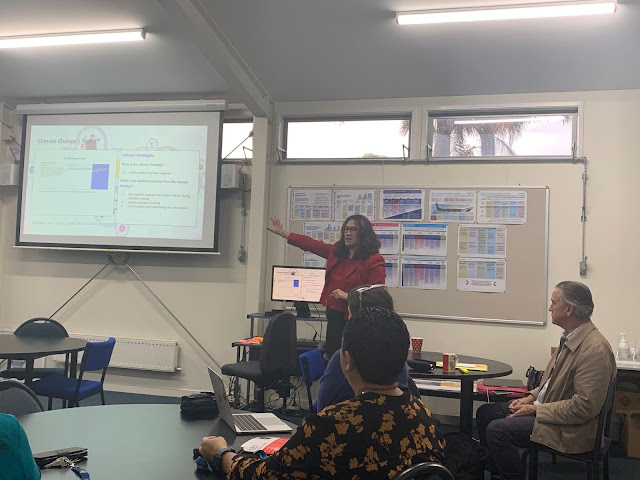


The following is the presentation slide deck that we used in the SLAM session.

Literacy Strategies - Year 10 Project | Climate Change and Game Development

It is important to note that in the process of breaking the tasks down for the learners, it wasn't a case of distributing the tasks like handouts and leaving them to navigate their way through the learning.  The students required feedback and/or feedforward so that the learning activities were useful for them, and equipped the learners to be able to write a final summary.  I used a Workspace to communicate the tasks with the learners and so that they could submit their work.  I used a tracking sheet to give students immediate feedback of the task, and used comments in their individual documents for students who needed feedforward to complete the work.

I am likely to integrate these same approaches with my target group for my 2021 CoL Inquiry this year.  Staff from other departments have shown interest in wanting to collaborate, with a particular interest in the Climate Change project, which Marc and I both welcome!


Share
Tweet
Pin
Share
No Comments

Begin to collect evidence and data  and come to the next session ready to share your preliminary findings about the nature and extent of the student challenge i.e. using your baseline student data and evidence

My target group of learners for my Inquiry 2021 will be my Year 12 NCEA Level 2 class. This group of learners were my target group from my 2020 Inquiry.


The following are two examples of evidence that I am in the process collecting to demonstrate my preliminary findings about the nature and extent of the student challenge.

Academic Writing using SOLO Taxonomy - Online Game

I asked the student to highlight and comment on various aspects of the example tasks within the slide deck, to highlight the various features of that particular aspect of SOLO Taxonomy.  The purpose of this exercise was to see whether or not the student understood the exemplars that were provided, and connect these to future work.

Whilst the student found the exercise to be useful.  It was also extremely time consuming.  So, in terms of this approach being meaningful for the student to use in future tasks or assessments, the timeliness of the task detracted away from the purpose or which the task was intended.  That is, very little work and essentially assessment work, would get completed if we focussed so much time on deconstructing and understanding the Academic Writing model, by following the approach that I'd set out for the student.  A classic example of 'Expectation' v 'Reality'!


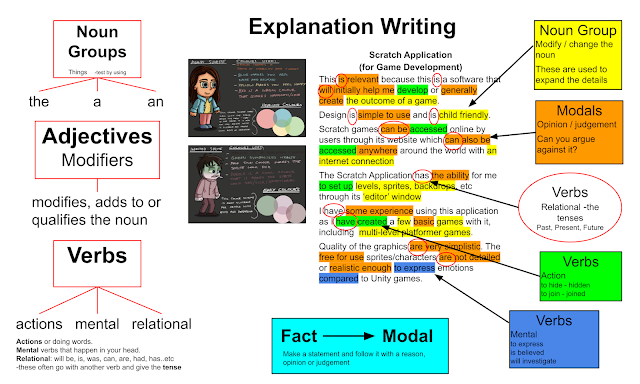
Explanation Writing Poster for Digital Technologies

I asked the students to use the Explanation Writing Poster for Digital Technologies, and highlight to text within their current Assessment Task using the same colour codes from the poster, as a means of gaining a better understanding of the assessment instructions.

The students are still in the middle of undertaking this process.  However, initial discussions that I have had with the students of terms of improving understanding of the assessment, is that this process has really useful.  I am hoping to see what their understanding of the assessment task actually is, through inquiry questions, once this approach has been completed.


Share
Tweet
Pin
Share
No Comments

Describe the tools/measures/approaches you plan to use to get a more detailed and accurate profile of students’ learning in relation to that challenge. Justify why you chose these approaches and tools.

My target group of learners for my Inquiry 2021 will be my Year 12 NCEA Level 2 class. This group of learners were my target group from my 2020 Inquiry.


The tools that I plan to use to get a more detailed and accurate profile of students' learning in relation to the challenge, includes both the Explanation Writing Poster for Digital Technologies, as well as the Academic Writing Slidedeck; both resources that I produced in collaboration with Marc Milford.


The reason that I would like to use the Explanation Writing Poster for Digital Technologies, is because it includes colour coded examples within the poster of various types of Writing Features, which students could potentially use and follow within their own writing tasks.  The students can also use this tool, to improve their understanding of reading materials that include a lot of new and technical vocabulary, such as Assessment Tasks.


The reason that I would like to use the Academic Writing Slidedeck, is because it also includes colour coded examples within the slides, and explanations of different levels of SOLO Taxonomy, that relates to a Digital Technologies outcome, which students should be able to relate to in this subject.  The examples of the different of SOLO Taxonomy, should enable students to develop their literacy and writing skills in alignment with the exemplars that have been provided.


Share
Tweet
Pin
Share
No Comments

From what you know already about your classes and your school’s profile and leadership goals for the year, share a possible inquiry focus.

Frame your focus as a desired change in student learning NOT a change in teaching (as yet!)

My target group of learners for my Inquiry 2021 will be my Year 12 NCEA Level 2 class. This group of learners were my target group from my 2020 Inquiry.


I would like to inquire into whether Academic Writing exemplars specific to Digital Technologies, in conjunction with the 'Explanation Writing' classroom display resources for Digital Technologies, based on SOLO taxonomy, could accelerate achievement in literacy in my subject.  

The desired change in student learning is that students will be able to write and achieve at Merit and Excellence levels for NCEA Level 2 achievement standards.


Share
Tweet
Pin
Share
No Comments

Collaborate with your school’s leadership team and colleagues to identify areas where your inquiry will make a powerful contribution to wider school and cluster goals.

My target group of learners for my Inquiry 2021 will be my Year 12 NCEA Level 2 class. This group of learners were my target group from my 2020 Inquiry.


The area that I feel my Inquiry will make a powerful contribution is in Literacy.  Literacy and Numeracy are part of the School Goals and Technology Department Goals for 2021.


School Goal 2 Literacy and Numeracy

By the end of Year 10, 80% of students will be reading at or above the expected level


By the end of Year 10, 70% of students are writing at or above the expected Curriculum Level.


By the end of Year 10 70% of students are achieving in Mathematics at or above the expected Curriculum Level.


That 90% of Year 11 students will achieve NCEA Literacy.


That 90% of Year 11 students will achieve NCEA Numeracy.


Department Goal 2 Literacy and Numeracy

Background - To develop an ‘Explanation Writing’ display poster.


Next Steps


As a department, the next steps is that we review the process, discuss the feedback and comments, and discuss what we would like to retain, adapt, change or remove, in order for this approach to be effective, and for literacy skills to improve for Technology students.


  1. What is the most effective way of utilising the Explanation Writing posters, with Technology students throughout the year?


  1. What is the most effective way of communicating shifts in achievement of Technology students, that reflects the use and application of the Explanation Writing posters and learning process?


I consulted with Marc Milford, Literacy Expert and Extraordinaire, as well as Karen Ferguson, fellow CoL, Techie and whose previous Inquiries have had a Literacy focus, about their thoughts around how my inquiry would make a powerful contribution to wider school and cluster goals.

Marc has been asking for Year 11 assessment tasks to critique, to help align current student writing at Tamaki College with NCEA Level 1 exemplars online.  Having previously provided me with support around literacy for my own practice, as well as the Technology Department, Marc is very keen to see my 2021 Inquiry continue along the Literacy focus, in alignment with both the School and Department Literacy Goals.  Marc is also keen to continue supporting me with my inquiry this year, which I believe will be instrumental in gaining critical feedback from somebody who is an expert in this field.

As the original developer of the Explanation Writing Exemplar, which is contributing towards my Inquiry focus this year, it was important that I spoke with Karen and gained her insight and feedback into my inquiry ideas around literacy.  Through our discussion, Karen could see how the ideas I was floating around, could offer the learners steps of support for literacy, by chunking down bigger concepts into smaller ones that learners could get their heads around.  It also helps that Karen's approach in many literacy learning activities, often start from the Unistructural (Yellow) section of the SOLO Taxonomy poster, and the activities staircase up from there.  Karen shared me a folder of learning resources that she has experimented with, to demonstrate various approaches with her learners.  

Although I understood that Literacy is a current and relevant area for Inquiry in terms of supporting student learning, it has helped to talk to others about their perspective, knowledge and experience working on literacy as well.


Share
Tweet
Pin
Share
No Comments

The following is a screencastify on a quick task that I've set with my learners, so that I know, that 'they' know, how to access their learning on my site.

This was a timely reminder for learners to know how to access their learning, while they are in the classroom, as well as when they are offsite including during lockdowns.  It is also an extremely useful for students who are new to my subject and are completely new to Tamaki College.


Accessing work in DigiTech


Share
Tweet
Pin
Share
No Comments

One of the Technology Department Goals for 2020 was based on Literacy, in alignment with the School Goal 2 for Literacy and Numeracy.  

The Technology Department Literacy Goal for 2020 is:

To develop ‘Explanation Writing’ classroom display resources for each specialist technology subject, based on SOLO taxonomy


I have been developing a slide deck of Academic Writing that relates to Game Development. The academic writing exemplar follows SOLO taxonomy, and I intend using this as an exemplar with my students, to support them to gain Merit and Excellence. I am seeking feedback and support from Marc Milford, after which, I will further develop the exemplar to follow the Explanation Writing model demonstrated in the poster.

This will enable a Visual Representation to be used on my classroom wall, Working Exemplars that the students can follow, and hopefully the consistency of the design, both within my own practice, and also across the department, will reinforce the key literacy features that we are wanting our learners to apply in their own work.

Academic Writing - Online Game 


The following is the first version of the slide deck that I have developed, which Marc is providing feedback for.  The slide deck follows the same format that Karen Ferguson developed for Design Writing for her learners.  I really like the SOLO Taxonomy images that Karen created, and the layout of her slides, which I feel will make the information easy to follow.


In addition, Marc has provided me with links to readings that support the Literacy process that I am working through for my learners.

I would like this to form the basis of my Inquiry for 2021, and so, will explore this in more detail.
Share
Tweet
Pin
Share
No Comments
Newer Posts
Older Posts

About Me

Kia ora! I am the Head of Technology at Tāmaki College and also teach Digital Technologies.


My target group of learners for my Inquiry 2021 will be my Year 12 NCEA Level 2 class. This group of learners were my target group from my 2020 Inquiry. I would like to inquire into whether Academic Writing exemplars specific to Digital Technologies, in conjunction with the 'Explanation Writing' classroom display resources for Digital Technologies, based on SOLO taxonomy, could accelerate achievement in literacy in my subject.


My target group of learners for my Inquiry 2020 were my Year 11 NCEA Level 1 class. I inquired into the process of using the LearnCoach online programs (content) and VTaL Visible Teaching and Learning (workflow) to accelerate student achievement for Tamaki College students undertaking courses in Digital Technologies NCEA Levels 1, 2 and 3.


In 2019, my inquiry is to maximise pedagogical practices (relating to integrated education, and collaborative teaching and learning), to effectively shift student achievement, supported by digital platforms connected to visible teaching and learning.


My Inquiry in 2018, was to develop a VTaL Purpose-Built Innovative Tool, to enable all elements of the VTaL Framework to be accessible to teachers, in order to accelerate student achievement.


In 2017, my inquiry was based on raising student achievement and shifting teacher practice around effective pedagogical practices including Learn, Create and Share. This will be achieved through the development, implementation and monitoring of the Visible Teaching and Learning Framework.

recent posts

Blog Archive

  • ▼  2022 (8)
    • ▼  March (3)
      • Hybrid Teaching and Learning | The impact of Omicron
      • Manaiakalani Toolkit | Well-being - Supporting Our...
      • Technology - Manaiakalani Department Discussions M...
    • ►  February (5)
  • ►  2021 (16)
    • ►  November (1)
    • ►  September (2)
    • ►  August (1)
    • ►  July (2)
    • ►  June (4)
    • ►  May (3)
    • ►  March (2)
    • ►  February (1)
  • ►  2020 (42)
    • ►  November (2)
    • ►  September (2)
    • ►  August (7)
    • ►  July (5)
    • ►  June (4)
    • ►  May (7)
    • ►  April (7)
    • ►  March (3)
    • ►  February (4)
    • ►  January (1)
  • ►  2019 (30)
    • ►  September (2)
    • ►  August (3)
    • ►  July (1)
    • ►  June (2)
    • ►  April (1)
    • ►  March (12)
    • ►  February (9)
  • ►  2018 (41)
    • ►  November (7)
    • ►  October (2)
    • ►  September (1)
    • ►  August (4)
    • ►  July (4)
    • ►  May (7)
    • ►  April (4)
    • ►  March (5)
    • ►  February (7)
  • ►  2017 (65)
    • ►  December (2)
    • ►  November (22)
    • ►  October (6)
    • ►  September (6)
    • ►  August (10)
    • ►  June (4)
    • ►  May (3)
    • ►  April (1)
    • ►  March (4)
    • ►  February (6)
    • ►  January (1)
  • ►  2016 (26)
    • ►  December (1)
    • ►  November (18)
    • ►  September (6)
    • ►  August (1)

VTaL

  • VTaL (104)
  • VTaL 01 Subject Sites (33)
  • VTaL 02 Learning Activities (7)
  • VTaL 03 Tracking Sheets (28)
  • VTaL 04 Student Checklists (12)
  • VTaL 05 Calendars with Links (24)
  • VTaL 06 Workspaces (32)
  • VTaL 07 Student Sites (4)
  • VTaL 08 Year Level Sites (3)
  • VTaL 09 Subject Communities (26)
  • VTaL 10 Student Blogs (11)
  • VTaL and Google Hangouts (15)
  • VTaL and Student Achievement (45)
  • VTaL for Parents (13)
  • VTaL for Students (82)
  • VTaL for Teachers (32)

Presentations

  • GAFE (19)
  • My YouTube Videos (8)
  • Presentations (21)

Inquiry

  • Inquiry (134)
  • Inquiry 2019 (27)
  • Inquiry 2020 (34)
  • Inquiry 2021 (15)

Manaiakalani

  • CoL (167)
  • Inquiry (134)
  • Inquiry 2020 (34)
  • Learn Create Share (11)
  • MIT 2018 (16)
  • Manaiakalani (18)
  • Presentations (21)
  • SPARK MIT (59)

Tamaki College

  • 2018 Department Goals (2)
  • 2018 School Goals (3)
  • 2019 Department Goals (2)
  • CoL (167)
  • Collaborative Learning Environments (32)
  • Covid19 (29)
  • Cultural Responsiveness (10)
  • Differentiation (12)
  • EMR Collaborative Project (21)
  • Goals (2)
  • Human Rights Collaborative Project (5)
  • Integrated Education (24)
  • Kia Eke Panuku (8)
  • LearnCoach (2)
  • Literacy (21)
  • PLD (18)
  • Techies (12)
  • Technological Modelling (4)

Practicing Teacher Criteria

  • PTC01 (31)
  • PTC02 (9)
  • PTC03 (6)
  • PTC04 (61)
  • PTC05 (17)
  • PTC06 (42)
  • PTC07 (32)
  • PTC08 (34)
  • PTC09 (8)
  • PTC10 (7)
  • PTC11 (16)
  • PTC12 (54)

General

  • CoL (167)
  • Collaborative Learning Environments (32)
  • Cultural Responsiveness (10)
  • Differentiation (12)
  • Feedback - Parent Voice (2)
  • Feedback - Staff Voice (6)
  • Feedback - Student Voice (23)
  • GAFE (19)
  • Goals (2)
  • Integrated Education (24)
  • Kia Eke Panuku (8)
  • LearnCoach (2)
  • Literacy (21)
  • My YouTube Videos (8)
  • Review (14)
  • Student Agency (15)

Contact Form

Name

Email *

Message *

Total Pageviews

Created with by BeautyTemplates| Distributed By Gooyaabi Templates